- MathNotebook
- MathConcepts
- StudyMath
- Geometry
- Logic
- Bott periodicity
- CategoryTheory
- FieldWithOneElement
- MathDiscovery
- Math Connections
Epistemology
- m a t h 4 w i s d o m - g m a i l
- +370 607 27 665
- My work is in the Public Domain for all to share freely.
- 读物 书 影片 维基百科
Introduction E9F5FC
Questions FFFFC0
Software
Bott periodicity, Bott Periodicity Chat GPT, Spin representation combinatorics, Bott Periodicity Poster
- Show how {$D_n$} relates to the linear components of the dimensions of the compact Lie groups.
- Relate the recursion relations to John's procedure.
- Relate to the two periodicities in "Bott Periodicity for Clifford Algebra maniacs".
- Relate to bigraded representations of CT groups.
- Relate to C,P,T quantum symmetries.
The Combinatorics of Bott Periodicity
Overview of Divisions of Everything
Bott periodicity provides insights into the structure of divisions of everything. Allegory
A division of everything assembles perspectives that together make up everything.
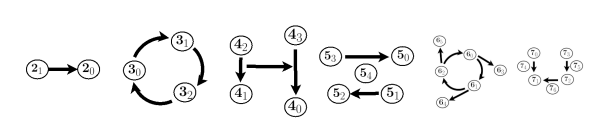
Given a perspective, we are either experiencing it directly (stepping-in) or indirectly (stepping-out). Perspectives get paired up so that we are experiencing one of them directly and the other indirectly. The pair is ordered. Our attention is on the perspective we experience directly. We experience a shift-in-perspective whereby our attention shifts from the one perspective to the other. The investigating mind understands this as a shift from the questioning mind to the answering mind.
We live these perspectives structurally, through the consciously questioning mind, and thus can be taken as statements of inconsistency, thus commitments to inconsistency. Mathematically, the corresponding generators square to {$-1$}. Alternatively, we could consider generators that square to {$+1$}. That would express the experience of the unconsciously answering mind but that would not be structural.
Each division of everything can be thought of as a nested sequence of shifts in perspective with possibly an extra perspective at the center of the sequence.
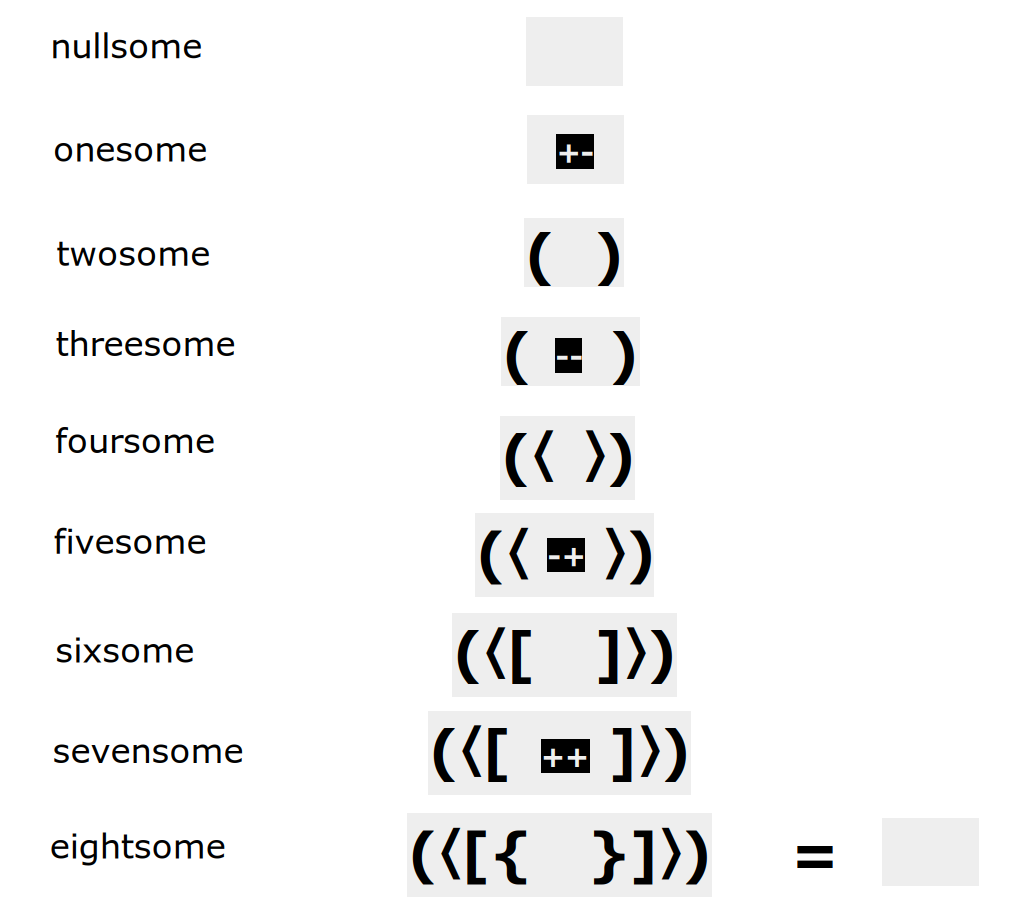 |  |
Each shift in perspective can be thought of as taking us from one perspective (a context) to another perspective (a concept). The mind is either in one state or the other. This can be written as {$10$} (the state before the shift) and {$01$} (the state after the shift). An extra perspective is understood as expressing the shift itself, its fourfold ambiguity: {$11, 10, 01, 11$}.
Each shift in perspective can be thought of as a frame that makes explicit one of the three minds.
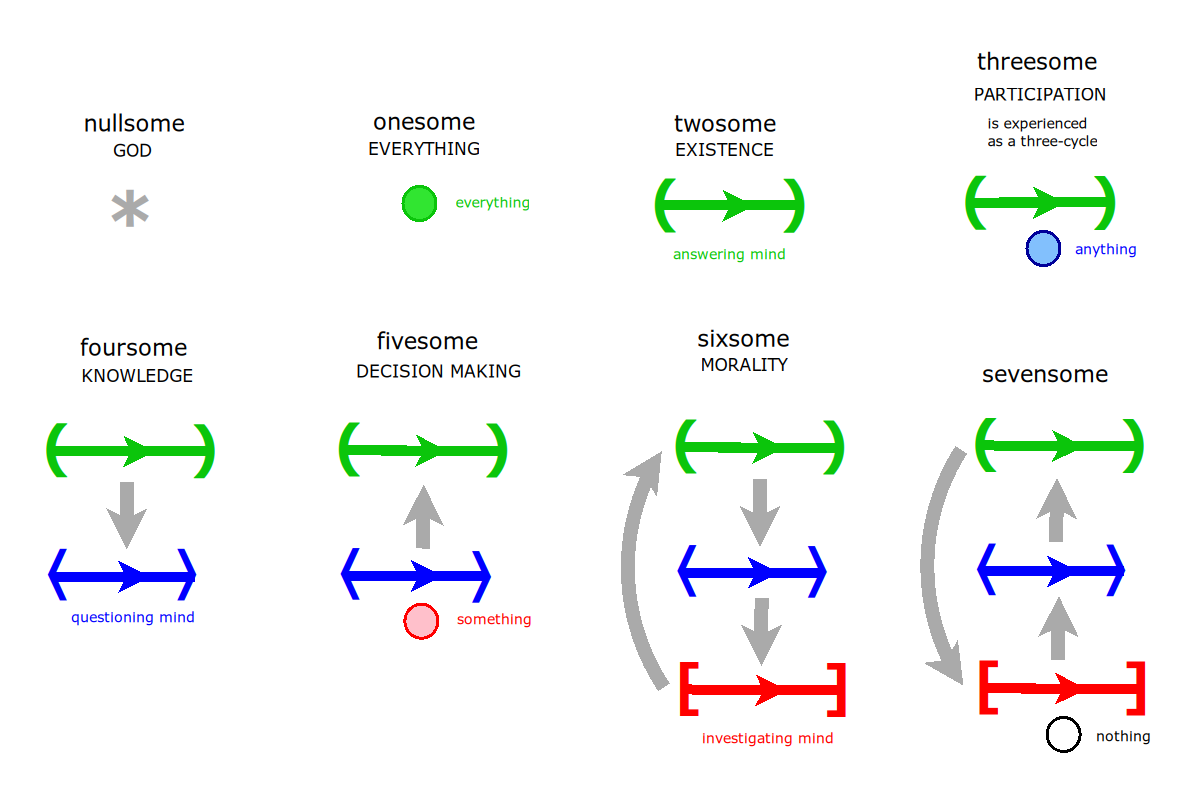
- The first shift in perspective, from "opposites coexist" (as in free will) to "all is the same" (as in fate), as in the twosome, makes explicit the unconsciously answering mind.
- It can be framed by a second shift in perspective, from "why" to "whether", as in the foursome, making explicit the consciously questioning mind.
- That can further be framed by a third shift in perspectivht, from "I am reflecting relatively, but am I reflecting absolutely?" to "I reflect but do I take a stand?" This is a shift in perspective between shifts in perspective. The system of three shifts in perspective form a three-cycle relating the answering mind, the questioning mind and the investigating mind.
- These could be framed by a fourth shift in perspective but that creates a collapse that results in no shifts in perspective. The collapse may be thought of as a return to the first shift in the three-cycle. We may also think of the fourth shift in perspective as defining the maintenance of a perspective so that there is actually no shift involved, yielding a contradiction. The context and the concept are the same perspective with regard to all three shifts in perspective. The scope in their difference has gone from everything to anything to something to nothing. The concept is simply a "required concept", as with the concept of everything, which actually expresses a context.
If there is an even number (zero, two, four) of shifts in perspective, then the division expresses what is inaccessible. If there is an odd number (one, three) of shifts in perspective, then the division expresses what is accessible.
When there is an odd number of perspectives, then the additional perspective is ambiguous. It can be identified with the shift-in-perspective of the innermost shift, the innermost frame. The extra perspective is understood to be beyond us, outside of our mind, standing independently. Then this extra perspective gets understood as two perspectives, thus a shift-in-perspective, a frame, a mind.
- In the case of the onesome, for the consciously questioning mind it is inconsistent and consistent, thus consistent. For the unconsciously answering mind it is consistent and consistent, thus inconsistent.
- In the case of the threesome, for the consciously questioning mind it is inconsistent and inconsistent, thus inconsistent. For the unconsciously answering mind it is inconsistent and consistent, thus consistent.
- In the case of the fivesome, for the consciously questioning mind it is consistent and inconsistent, thus consistent. For the unconsciously answering mind it is inconsistent and inconsistent, thus inconsistent.
- In the case of the sevensome, for the consciously questioning mind it is consistent and consistent, thus inconsistent. For the unconsciously answering mind it is consistent and inconsistent, thus consistent.
This makes for a fourfold periodicity on this additional perspective. Also, the consciously questioning mind and the unconsciously answering mind draw opposite conclusions, experiencing it in opposite ways.
When we have an odd number of perspectives, we have an extra perspective, which is a double possibility, internally, taking one of four forms (+-,--,-+,++):
- {$+ -$} onesome: the extra perspective is everything (the onesome describes everything)
- {$- -$} threesome: the extra perspective is anything (any of the three perspectives can be understood as a shift in perspective between the other two)
- {$- +$} fivesome: the extra perspective is something (the critical point for deciding, the present or boundary)
- {$+ +$} sevensome: the extra perspective is nothing (there exists a known and there exists an unknown)
Where the extra perspective is within the others, which establish a concept and context on either side, as in the generating of Clifford algebras with two step recursions.
The additional perspective is interpreted as a shift in perspective regarding the highest level of awareness to that point.
The additional perspective is that by which a division of everything expresses what is both accessible and inaccessible, thus definable. This comes from my study of quantum symmetries and I need to relate this to the pairs of perspectives.
I need to understand the meaning of the {$+$} and {$-$} signs.
Eight perspectives lead to a collapse. This can be understood in several ways.
- Nothing spawns a shift-in-perspective that is the default frame, thus the removal of all explicit frames.
- The third frame establishes a three-cycle of frames. A fourth frame would repeat the first frame thus not be distinct.
- When all are known and all are unknown, then the system must be empty.
I need to understand how this arises from an interpretation of the combinatorics.
Overall, Bott periodicity relates the external syntax of shifts-in-perspective (functioning as frames)(interpreted as with the internal semantics inherent in the ambiguity of the extra perspective.
Overview of the Three Minds
The three minds - unconsciously answering, consciously questioning, cognizantly investigating - are three levels of awareness. They are three operations on divisions of everything, adding one perspective, or two perspectives (a perspective on a perspective), or three perspectives (a perspective upon a perspective on a perspective).
Sign sequences
The three minds are the three sign sequences. Multiplying two sign sequences yields the alternating sequence (the third mind).
A set of three discriminators: Clifford mappings
Modeling the three minds can mean understanding them with regard to each other, thus a set of three options. Furthermore, these options can be understood as instruments that help to distinguish the eight mental contexts that real eightfold Bott periodicity cycles through.
The three minds can be understood as Clifford algebra mappings (reversion, conjugation, involution).
- Reversion is the effect of the answering mind.
- Conjugation is the effect of the questioning mind. It is just like reversion but switches the sign of each generator.
These two are antiautomorphisms because they switch the order. They are important in discrimating the shifts in perspectives, which is to say, the frames. There can be 0, 1, 2 or 3 frames and in each case the two antiautomorphisms supply us with a different combination of answers. But 4 frames is the same as 0 frames.
| conjugation | reversion | involution | |
| {$(-1)^{n(n+1)/2}$} | {$(-1)^{n(n-1)/2}$} | {$(-1)^n$} | |
| sign of {$w_n^2$} | |||
| n | sign of {$(-F_n)\cdots (-F_2)(-F_1)$} | sign of {$F_n\cdots F_2F_1$} | sign of {$(-F_1)(-F_2)\cdots (-F_n)$} |
| 0 | + | + | + |
| 1 | - | + | - |
| 2 | - | - | + |
| 3 | + | - | - |
| 4 | + | + | + |
Involution is just the product of these. So it tells us nothing more here.
However, we can apply involution to the perspective directly. Then they tell us if we have an even or odd number of perspectives. Thus they tell us if we have an extra perspective or not.
Involution is an automorphism acting directly on perspectives. Whereas reversion and conjugation are antiautomorphisms and they act on shifts in perspective.
A set of three discriminators: quantum symmetries
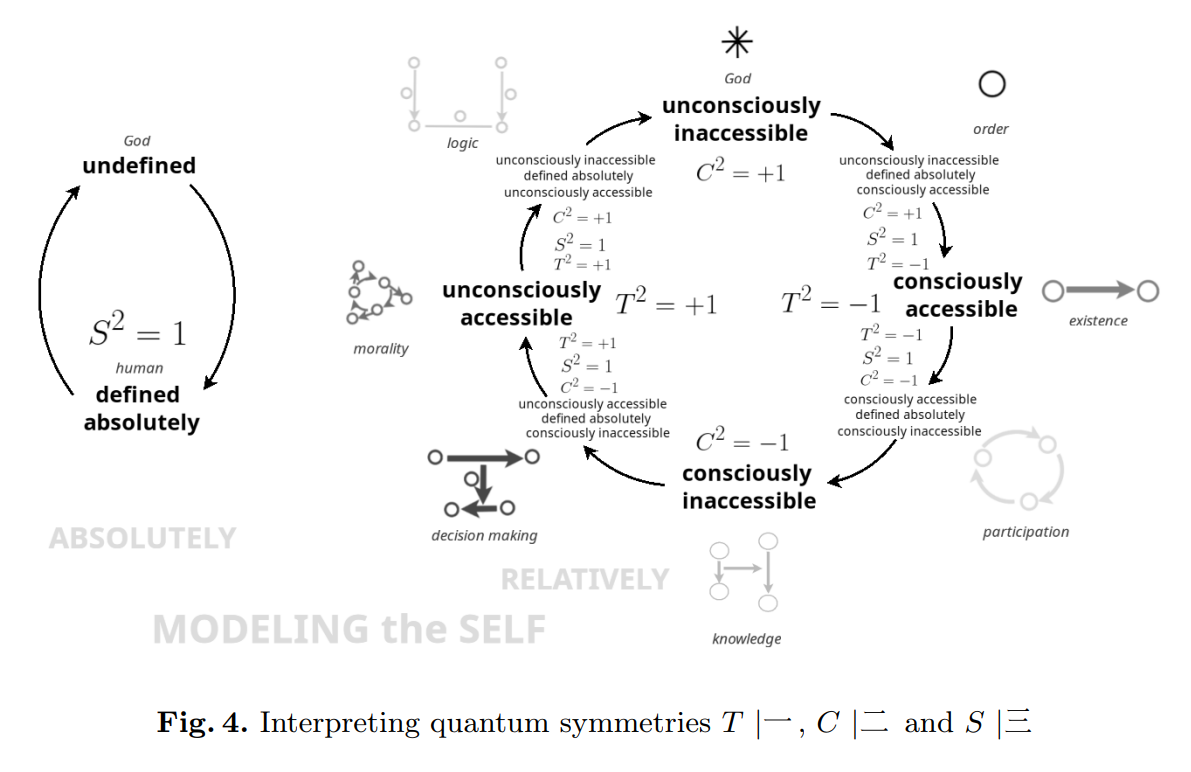
The three minds can also be understood as quantum symmetries (time reversal, charge conjugation, sublattice) which a Hamiltonian may obey, and by which a perspective is inaccessible, accessible and definable.
If a generator squares to {$+1$}, then it models the unconsciously answering mind, whereas if it squares to {$-1$}, then it models the consciously questioning mind.
| Three minds | answering | questioning | investigating |
| Quantum symmetries | time reversal {$T$} | conjugation {$C$} | sublattice {$S$} |
| inaccessible | accessible | definable | |
| squares to | unconsciously {$+1$} | consciously {$-1$} | |
| Clifford maps | reversion | conjugation | involution |
Adding one or two or three perspectives
Each mind is also modeled by the number of perspectives that it adds.
Thus John Harland's recursion adds one perspective at a time. This is also the Clifford algebra extension problem.
The Clifford algebra recursion relation {$Cl_{0,p+2}=\mathbb{H}\otimes Cl_{p,0}$} adds two perspectives at a time. It works with the recursion relation {$Cl_{p+2,0}=M_2(\mathbb{R})\otimes Cl_{0,p}$} to express the Clifford algebras in matrix form with minimal dimensions. These recursion relations make it straightforward to express the linear complex structures {$J_1, \cdots, J_8$, \cdots$}. We can think of them as adding a shift in perspectives. Although they appear to add {$J_1,J_2$}, they actually add {$J_{k+1}, J_{k+2}$}.
A geodesic also models the addition of a product of two perspectives.
The loopspace adjunction models the addition of two perspectives.
Combinatorial fundamentals
The three minds can be identified with sequences:
- Consciousness: {$+ - + - + - \cdots$}
- Conscious: {$+ - - + + - - + + - - + + - - \cdots$}
- Unconscious: {$++ - - + + - - + + - - + + - - \cdots$}
The latter two are the two ways of reading the first sequence twice as slow.
Multiplying the signs in the last two rows gives the sign in the first row. So we can think of this as eight equations. They may relate to the additive equation which relates the three operations: {$(+2)(+1)=(+3)$}. The three operations act on the half-speed of consciousness. Thus we can think of them as adding steps {$\frac{1}{2}, 1, \frac{3}{2}$} with regard to {$4$}. We can think of it as the conscious adding a shift-in-perspective and then the unconscious adding a perspective upon that.
In a Clifford algebra, a (monomial) term includes each generator at most once. Thus the term indicates membership. Algebraically, this is achieved by having it square to a scalar. Ignoring absolute magnitude, and avoiding degeneracy, that scalar will be {$+1$} or {$-1$}. Squaring to the scalar also establishes a duality between membership expressed statically, explicitly (the generator is in the term) and expressed dually by the action which adds it (and removes it if it is already there).
Taken all together we have:
| {$+$} |
| {$+-$} |
| {$-$} |
| {$--$} |
| {$-$} |
| {$-+$} |
| {$+$} |
| {$++$} |
The Combinatorial Mechanism of Bott Periodicity
The combinatorics of Bott periodicity is based on the rows of Pascal's triangle. They express the combinatorics of how the {$2^k$} elements of the basis of a Clifford algebra {$Cl_{0,k}$} is given by the subsets of {$\{e_1,\dots ,e_k\}$}, their products in the expansion {$(1+e_1)(1+e_2)\cdots (1+e_k)$}.
Combinatorially, Bott periodicity is based on the symmetry of a sequence of {$k$} positions, written from left to right. There is a natural pairing of leftmost and rightmost positions, with an extra position remaining in the center when {$k$} is odd. A position {$j$} may be filled (if the basis element includes {$e_j$}) or not (if it does not). We can indicate this with signs {$1$} and {$0$} accordingly. Bott periodicity pairs up and removes terms in which a left-right pair is {$11$} or {$00$} and keeps terms in which each left-right pair is of form {$10$} or {$01$}.
For example, when we have strings of length {$k=4$}, and we start from the outside and move inward, then first we have the following cancellations of eight terms:
{$0110\Leftrightarrow 1111, 0100 \Leftrightarrow 1101, 0010 \Leftrightarrow 1011, 0000 \Leftrightarrow 1001 $}
so that the terms have the form {$0..1$} or {$1..0$}. Then working inwards, culling further, we have additional cancellations of four terms:
{$0111\Leftrightarrow 0001, 1000\Leftrightarrow 1110$}
and we are left with four terms: {$0011, 0101, 1010, 1100$}. Note that the leftmost two positions determine the rightmost two positions, which have the opposite values. Thus we are taking the square root of {$2^4=16$}, which is {$2^2=4$}.
The surviving terms are those for which the terms on the left are followed by their opposites on the right, in reverse order. When we have an even number of positions, we are taking the square root. When we have an odd position, it is not affected by this culling, and so it can be either 0 or 1. Thus in the odd case {$2k+1$}, we have twice the number of terms as in the even case {$2k$}, and depending on the sign sequence, the sum may be zero (if the extra 1 switches the sign) or the sum may be doubled (if the extra 1 does not switch the sign).
Thus in the case of {$n=3$} we have two terms with a single {$1$}, namely, {$001, 100$}. And we have two terms with two {$1$}'s: {$011,110$}. If the sign sequence is {$+,-,-,\cdots$}, then the terms with a single {$1$} have a positive sign but the terms with two {$1$}'s will have a negative sign, and the total sum will be zero. Whereas if the sign sequence is {$+,+,-,-,\cdots$}, then both contributions will be positive and the sum will double what we had for {$n=2$}.
Similarly, in the case of {$n=5$} we have four terms with two {$1$}'s: {$00011, 01001, 10010, 11000$} and we have four terms with three {$1$}'s: {$00111, 01101, 10110, 11100$}. If the sign sequence is {$+,-,-,\cdots$}, then both contributions are negative and their sum will double the answer for {$n=4$}. Whereas if the sign sequence is {$+,+,-,-,\cdots$}, then the first contribution is positive but the second contribution is negative and their sum is zero.
Combinatorially, algebraically, the culling requires that the associated terms with {$1...1$} and {$0...0$} have opposite sign. This means that terms which are two positions apart must have opposite sign. If A and B are opposite signs, then the sequence is determined by the first two positions. If we assume A is in the first position, then we have two possible continuations:
- ABBAABBAABB...
- AABBAABBAABB...
Furthermore, A can be + or -. So we have four possible sequences in all:
- +--++--++-- ...
- ++--++--++-- ...
- -++--++--++-- ...
- --++--++--++-- ...
The latter two sequences are simply negatives of the former two sequences. All four sequences have fourfold periodicity. They can be identified with the trigonometric functions {$\frac{\sqrt{2}}{2}\cos \frac{(2n+1)\pi}{4}, \frac{\sqrt{2}}{2}\sin \frac{(2n+1)\pi}{4}, -\frac{\sqrt{2}}{2}\cos \frac{(2n+1)\pi}{4}, -\frac{\sqrt{2}}{2}\sin \frac{(2n+1)\pi}{4}$}
When we have an odd number of positions, then the extra position takes on both values, {$0$} and {$1$}, which are given adjacent signs in the relevant sequence above. The adjacent signs can both be positive (doubling the value) or both be negative (doubling the value) or be of opposite signs (so that the value adds up to zero).
We can do the culling without algebra. But since we do the culling using algebra, we introduce sign sequences. Consequently, the terms for the extra perspective cancel out when the two sources have opposite sign. But having two different sign sequences allows us to reconstruct the information.
The Combinatorics of Twofold Complex Bott Periodicity
In Pascal's triangle, the {$n$}-th row presents the {$\binom{n}{k}$} ways of choosing {$k$} from {$n$}. There are {$n+1$} options for {$k$}, namely {$k=0,1,\cdots ,n-1,n$}.
We can identify what is chosen as part of everything, which is explicit, and what is not chosen as part of God, which is implicit.
We can pair up opposites - what is chosen and what is not chosen - and this cuts the elements in half. And we can express those opposites in two different ways, affirming the opposite (as when opposites coexist) or negating it (as when truth is affirmed but falsehood is negated). Affirming is modeled with the positive sign and negating is modeled with the negative sign.
If {$n=2m+1$} is odd, then there are an even number {$n+1=2m+2$} of options. There are two equal, maximal, central options {$\binom{2m+1}{m} = \binom{2m+1}{m+1}$}. There is a sum of two representations. We get them by considering the pseudoscalar, the volume, everything {$\omega = e_1e_2\cdots e_n$}. Multiplying this by any term (of what was chosen from amongst the generators) gives the product of what was not chosen. So the projections {$p_\pm=\frac{1\pm\omega}{2}$} make explicit both what was chosen and what was not chosen. They define ideals. In one case, what was not chosen is given the postive sign and in the other case, the negative sign. We have {$Cl_{2m+1}p_+\cong Cl_{2m}\cong Cl_{2m+1}p_-$} and {$Cl_{2m+1}=Cl_{2m+1}p_+\oplus Cl_{2m+1}p_-$}. Combinatorially, by Vandermonde's identity:
{$\binom{2m}{k}+\binom{2m}{k-1}=\sum_{p+q=k}\binom{2m}{p}\binom{1}{q}=\binom{2m+1}{k}$}
If {$n=2m$} is even, then there are an odd number {$n+1=2m+1$} of options. A single central option {$\binom{2m}{m}$} applies both for counting the chosen and for counting the unchosen. There is a single irreducible representation. We have {$Cl_{2m}\cong M_{2^m}(\mathbb{C})$}. This is shown given a basis {$f_1,\cdots ,f_n$} for {$V=\mathbb{C}^m$}, which are generators of the spinor space {$S=\Lambda^*V$} and defining wedge operators {$\epsilon_j(v)=f_j\wedge v$} and contraction operators {$\iota_j$} and defining pairs of operators {$\gamma_{2j-1}=\epsilon_j+\iota_j$} and {$\gamma_{2j}=i(\epsilon_j-\iota_j)$}, which both square to {$+1$}, and serve as Clifford algebra generators. These operators add {$f_j$} if a term does not have them, and remove {$f_j$} if a term has them. We see that these generators need to come in pairs and they are acting on {$S$}, which has dimension {$2^m$}. So the complex Clifford algebra can be understood as the row {$2m$} of Pascal's triangle which acts on the row {$m$} of Pascal's triangle. Combinatorially, this is convolution and is given by Vandermonde's identity:
{$\sum_{p+q=k}\binom{m}{p}\binom{m}{q}=\binom{2m}{k}$}
Thus complex Bott periodicity distinguishes what is reducible (the odd case, with an extra perspective, which has an even number of options, and two maximal options, and thus the freedom amongst them) and what is irreducible (the even case, which has an odd number of options, and only one maximal option, with no freedom). The extra perspective allows that there is something beyond us which we may or may not live through.
{$(1+i)^n$}
The number of terms generated at the {$k$}-th stage is {$2^k$}. The culling process - the sign-reversing involution - reduces the number of terms to {$D_k$} or {$E_k$}. The sign sequence used determines which sequence is output and the ultimate signs.
| {$n$} | {$D_n$} | {$E_n$} | ||
| 0 | 1 | 1 | 1 | 1 |
| 1 | 0 | 1-1 | 2 | 1+1 |
| 2 | -2 | 1-2-1 | 2 | 1+2-1 |
| 3 | -4 | 1-3-3+1 | 0 | 1+3-3-1 |
| 4 | -4 | 1-4-6+4+1 | -4 | 1+4-6-4+1 |
| 5 | 0 | 1-5-10+10+5-1 | -8 | 1+5-10-10+5+1 |
| 6 | 8 | 1-6-15+20+15-6-1 | -8 | 1+6-15-20+15+6-1 |
| 7 | 16 | 1-7-21+35+35-21-7+1 | 0 | 1+7-21-35+35+21-7-1 |
| 8 | 16 | 1-8-28+56+70-56-28+8+1 | 16 | 1+8-28-56+70+56-28-8+1 |
Note that when {$n$} is even, then {$D_n$} and {$E_n$} have the same absolute value but they cycle through the possible sign combinations. Their combinatorics is the same but it is simply the matter of the sign of the central choice {$\binom{n}{\frac{n}{2}}$}. And when {$n$} is odd, then one of them is zero and the other is not. So now they are summing the central two binomial values and either they have opposite signs and add to zero, or they have the same sign and double the value.
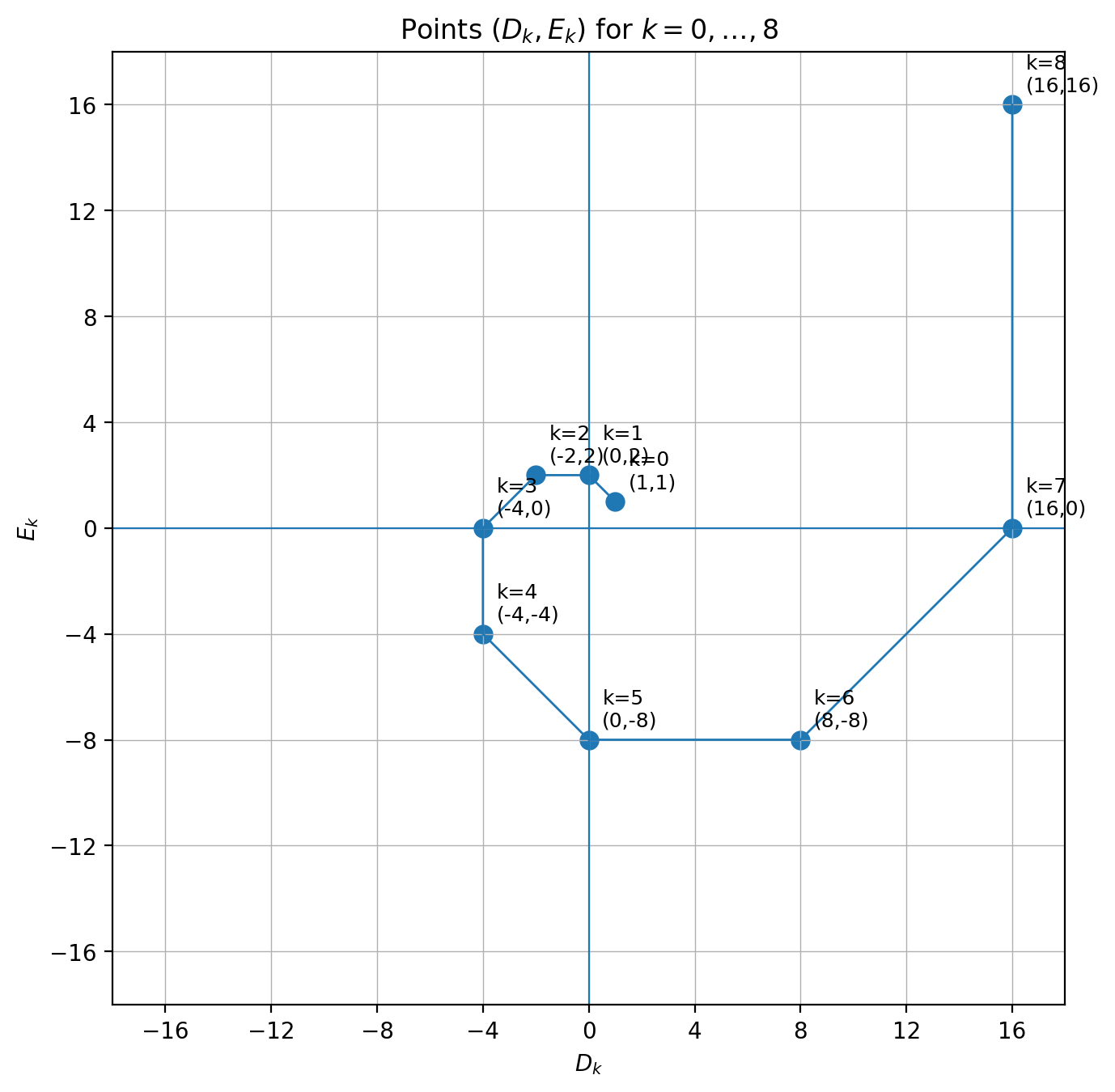
The fourfold sequences can be identified with the {$x,y$} coordinates of the expressions {$(1+i)^n = (\sqrt{2}e^{\frac{\pi}{4}})^n$} and {$(1-i)^n = (\sqrt{2}e^{-\frac{\pi}{4}})^n$} which are proportional to the eighth root of unity. Rotating in the positive direction (counterclockwise) {$(1+i)^n$} models the unconsciously answering mind, and rotating in the negative direction (clockwise) {$(1-i)^n$} models the consciously questioning mind.
The {$x,y$} coordinates are given as {$D_n$} and {$E_n$}.
{$$D_n=\sqrt{2}^{n+1} \cos ((n+1)\frac{\pi}{4})$$}
{$$D_n= \sqrt{2}^n( \cos \frac{\pi}{4}n - \sin \frac{\pi}{4}n)$$}
{$$D_n=\textrm{Re}(1+i)^{n+1}$$}
{$$E_n=\sqrt{2}^{n+1} \sin ((n+1)\frac{\pi}{4})$$}
{$$E_n= \sqrt{2}^n( \cos \frac{\pi}{4}n + \sin \frac{\pi}{4}n)$$}
{$$E_n=\textrm{Img}(1+i)^{n+1}$$}
In summary,
{$$D_n+iE_n=(1+i)^{n+1}$$}
{$(1+i)$} as a matrix
{$\begin{pmatrix} D_{n+1} \\ E_{n+1} \\ \end{pmatrix} = \begin{pmatrix} 1 & -1 \\ 1 & 1 \\ \end{pmatrix}\begin{pmatrix} D_{n} \\ E_{n} \\ \end{pmatrix}$}
This is the matrix form of multiplication by {$1+i$}. It rotates the vector by {$45^\circ$} and multiplies the length by {$\sqrt{2}$}.
Similarly, we can invert this to get the matrix form of multiplication by {$1-i$}.
This matrix form of multiplication by {$1+i$} also relates the Lie groups.
{$\textrm{dim} G_n=\frac{1}{2}(2^nr^2-E_nr)$}
{$\textrm{dim}(G_{n+1}/G_n)=\textrm{dim}G_{n+1}-\textrm{dim}G_n=\frac{1}{2}(2^nr^2-D_nr)$}
Note that {$1\pm i$} expresses the twosome, the division of everything into two perspectives: opposites coexist {$\pm i$} and all is the same {$1$}.
I know the combinatorial algorithm behind both {$D_n$} and {$E_n$}. It is the same algorithm but simply the signs are positioned differently, which affects the odd rows.
The combinatorics for {$D_{n+1}=D_n-E_n$} and {$E_{n+1}=D_n+E_n$}
Note that {$D_n$} and {$E_n$} are the same size when {$n$} is even. All that may differ is the sign. The sign depends on the what sign is attributed to {$\binom{n}{\frac{n}{2}}$}. And when {$n$} is odd, then precisely one of {$D_n$} and {$E_n$} is {$0$}, which happens because the two central choices have opposite signs. Otherwise, the two central choices have the same sign and we are counting the fixed points of the algorithm.
This is very much the combinatorics of {$(1+i)^n=\sqrt{2}e^{\frac{\pi}{4}}$}.
{$D_n$} is the trace of conjugation and {$E_n$} is the trace of reversal. As regards the sign sequence, {$D_n$} is one step ahead of {$E_n$}, which is one step ahead of {$-D_n$}, which is one step ahead of {$-E_n$}, which is one step ahead of {$D_n$}. Analogously, {$\cos x$} is ahead of {$\sin x$} in the sign sequence, which is ahead of {$-\cos x$}, which is ahead of {$-\sin x$}, which is ahead of {$\cos x$}.
Thus the questioning mind (conjugation) is one step ahead of the answering mind (reversal). The questioning mind is predictive.
| {$n$} | {$D_n$} | {$E_n$} | magnitude |
| 0 | {$+$} | {$+$} | 1 |
| 1 | {$+ -$} | {$+ +$} | 2 |
| 2 | {$-$} | {$+$} | 2 |
| 3 | {$- -$} | {$+ -$} | 4 |
| 4 | {$-$} | {$-$} | 4 |
| 5 | {$- +$} | {$- -$} | 8 |
| 6 | {$+$} | {$-$} | 8 |
| 7 | {$+ +$} | {$- +$} | 16 |
| 8 | {$+$} | {$+$} | 16 |
The reading of the sign sequence proceeds by half-step. We go from the position of a single sign to the position between it and the next sign, and then to the position of that next sign. In this sense, the center moves by half-step.
The number that appears in the magnitude doubles when we go from a single sign to a double sign, for the double sign (when it is nonzero), combines two single signs. Whereas the actual size is the square root of the squares of both {$D_n$} and {$E_n$}, and that grows by {$\sqrt{2}$}.
The sign is read off from the sign sequence. The exception is that when the double sign consists of opposites (such as {$+-$} or {$-+$}), then we get {$0$}.
We get two sequences for the signs:
- {$D_n: + 0 - - - 0 + + \cdots $}
- {$E_n: + + + 0 - - - 0 \cdots $}
So we get two minds that have the same information (the same sign sequence) but one mind is one step ahead of the other. Or it is three steps behind the other. And the sign sequence alternates every second step, thus relates two such alternations.
We can think of this as a four-step algorithm with two states.
- {$D_n=E_n$}
- {$D_{n+1}=0, E_{n+1}\neq 0$}
- {$D_{n+2}=-E_{n+2}$}
- {$D_{n+3}\neq 0, E_{n+3}=0$}
This takes us from {$D_n,E_n>0$} to {$D_{n+4},E_{n+4}<0$}. And four more steps take us back.
Clifford algebra mappings: reversion, conjugation, involution
Define the Clifford algebra antiautomorphisms
- reversion {$\tau(e_1e_2\cdots e_{k-1}e_k) = e_k e_{k-1}\cdots e_2e_1=(-1)^{\frac{k(k-1)}{2}}e_1e_2\cdots e_{k-1}e_k$}
- conjugation {$\sigma(e_1e_2\cdots e_{k-1}e_k) = (-e_k)(-e_{k-1})\cdots (-e_2)(-e_1)=(-1)^{\frac{k(k+1)}{2}}e_1e_2\cdots e_{k-1}e_k$}
And the Clifford algebra automorphism
- involution {$\nu(e_1e_2\cdots e_{k-1}e_k) = (-e_1)(-e_2)\cdots (-e_{k-1})(-e_k)=(-1)^ke_1e_2\cdots e_{k-1}e_k$}
Consider the Clifford algebras {$Cl_{0,n}$} with {$n$} generators {$e_k$} which all square to {$-1$}.
{$$D_n=\textrm{Tr}(\sigma)=\sum_{k=0}^n \binom{n}{k}(-1)^{k(k+1)/2}$$} where {$\sigma$} is conjugation
Consider the Clifford algebras {$Cl_{n,0}$} with {$n$} generators {$e_k$} which all square to {$+1$}. The sequence {$E_n$} gives the number of basis elements that square to {$+1$} minus the number that square to {$-1$}.
{$$E_n=\textrm{Tr}(\tau)=\sum_{k=0}^n \binom{n}{k}(-1)^{k(k-1)/2}$$} where {$\tau$} is reversion
Clifford algebra matrix representations
Consider how {$D_n$} and {$E_n$} relate to the matrix representations of Clifford algebras.
| {$n$} | {$D_n$} | {$E_n$} | ||||
| 0 | 1 | 1 | {$\mathbb{R}$} | 1 | 1 | {$\mathbb{R}$} |
| 1 | 0 | 1-1 | {$\mathbb{C}$} | 2 | 1+1 | {$\mathbb{R}\oplus\mathbb{R}$} |
| 2 | -2 | 1-2-1 | {$\mathbb{H}$} | 2 | 1+2-1 | {$M_2(\mathbb{R})$} |
| 3 | -4 | 1-3-3+1 | {$\mathbb{H}\oplus\mathbb{H}$} | 0 | 1+3–3–1 | {$M_2(\mathbb{C})$} |
| 4 | -4 | 1-4-6+4+1 | {$M_2(\mathbb{H})$} | -4 | 1+4-6-4+1 | {$M_2(\mathbb{H})$} |
| 5 | 0 | 1-5-10+10+5-1 | {$M_4(\mathbb{C})$} | -8 | 1+5-10-10+5+1 | {$M_2(\mathbb{H})\oplus M_2(\mathbb{H})$} |
| 6 | 8 | 1-6-15+20+15-6-1 | {$M_8(\mathbb{R})$} | -8 | 1+6-15-20+15+6-1 | {$M_4(\mathbb{H})$} |
| 7 | 16 | 1-7-21+35+35-21-7+1 | {$M_8(\mathbb{R})\oplus M_8(\mathbb{R})$} | 0 | 1+7-21-35+35+21-7-1 | {$M_8(\mathbb{C})$} |
| 8 | 16 | 1-8-28+56+70-56-28+8+1 | {$M_{16}(\mathbb{R})$} | 16 | 1+8-28-56+70+56-28-8+1 | {$M_{16}(\mathbb{R})$} |
When the generators all square to {$-1$}:
- {$D_n$} is the trace of conjugation. It determines the underlying division ring - real numbers, complex numbers, quaternions - based on the trace of the conjugate, yielding, respectively: 1, 0, -2. And that is related to the self-relation, the diagonal component of the independent equations for the compact Lie group, yielding the linear component of their dimensions.
- {$E_n$} is the trace of reversion. It determines the nature of the algebra, whether it is pre-split, split, post-split or complex. When {$n$} is odd, then {$\omega = e_1e_2\cdots e_n$} is central (it commutes with all elements). When {$n=2m+3$}, then {$\omega^2=+1$} and we have two central idempotents {$p_\pm = \frac{1\pm \omega_n}{2}$} so that the Clifford algebra splits into two simple pieces.
When the generators all square to {$+1$} we have the opposite. In either case the combinatorics is basically the same.
{$D_n$} and {$E_n$} together specify the matrix representation of the Clifford algebras. Thus they establish eightfold Bott periodicity.
Vector space embeddings
Fix a vector space {$V=\mathbb{R}^{16r}$}. The Clifford algebra {$Cl_{0,n}$} acts on it. We think of {$V$} as a {$Cl_{0,n}$} module and we can write it as a direct sum of copies of an irreducible module: {$V\cong S_n\oplus S_n \oplus \cdots \oplus S_n$}. We can package these copies, writing {$V\cong S_n\otimes_{\mathbb{F}^n}W_n$} where {$W_n$} is the multiplicity space which expresses how many copies of {$S_n$} occur inside of {$V$}.
A transformation which commutes with the Clifford action must act only on the remaining factor. As the Clifford algebra grows, the remaining factor decreases. The transformation is an action on the vector space.
Topologically, the polar decomposition {$A=PU$} shows that every matrix can be factored as a positive definite {$P$} and an isometry {$U$}. The positive definite factor {$P$} (the absolute magnitude) does not contribute to the topology. Topologically, we can focus on the isometry {$U$}, which includes the effects of the sign.
| {$n$} | Clifford structure {$Cl_{0,n}$} | multiplicity space {$W_n$} | commutant | transformations preserving the inner product |
| {$0$} | none | {$\mathbb{R}^{16r}$} | {$M_{16r}(\mathbb{R})$} | {$O(16r)$} |
| {$1$} | {$\mathbb{C}$} | {$\mathbb{C}^{8r}$} | {$M_{8r}(\mathbb{C})$} | {$U(8r)$} |
| {$2$} | {$\mathbb{H}$} | {$\mathbb{H}^{4r}$} | {$M_{4r}(\mathbb{H})$} | {$Sp(4r)$} |
| {$3$} | {$\mathbb{H}\oplus\mathbb{H}$} | {$\mathbb{H}^{2r}\oplus \mathbb{H}^{2r}$} | {$M_{2r}(\mathbb{H})\oplus M_{2r}(\mathbb{H})$} | {$Sp(2r)\otimes Sp(2r)$} |
| {$4$} | {$M_2(\mathbb{H})$} | {$\mathbb{H}^{2r}$} | {$M_{2r}(\mathbb{H})$} | {$Sp(2r)$} |
| {$5$} | {$M_4(\mathbb{C})$} | {$\mathbb{C}^{2r}$} | {$M_{2r}(\mathbb{C})$} | {$U(2r)$} |
| {$6$} | {$M_8(\mathbb{R})$} | {$\mathbb{R}^{2r}$} | {$M_{2r}(\mathbb{R})$} | {$O(2r)$} |
| {$7$} | {$M_8(\mathbb{R})\oplus M_8(\mathbb{R})$} | {$\mathbb{R}^{r}\oplus \mathbb{R}^{r}$} | {$M_{r}(\mathbb{R})\oplus M_{r}(\mathbb{R})$} | {$O(r)\times O(r)$} |
| {$8$} | {$M_{16}(\mathbb{R})$} | {$\mathbb{R}^{r}$} | {$M_{r}(\mathbb{R})$} | {$O(r)$} |
Dimensions in the Lie group embeddings
Note that the {$\textrm{dim}\;GL(n,\mathbb{R})=n^2$}. There are {$n^2$} entries and the constraint is that the determinant (a polynomial) is nonzero. That constraint does not affect the dimension.
Consider the embedding of Lie groups:
{$O(r)\subset O(r)\times O(r) \subset O(2r) \subset U(2r)\subset Sp(2r)\subset Sp(2r)\times Sp(2r) \subset Sp(4r)\subset U(8r) \subset O(16r)$}
The dimension of the compact Lie group is given by the number of independent equations that make up {$MM^\dagger=I$} where {$\dagger$} is the conjugate transpose. Thus we have to consider the dimension {$d$} of the division algebra ({$1$} for real numbers, {$2$} for complex numbers, {$4$} for quaternions) which give the entries of the matrices. Note that we have an equation for each entry (each pair) {$i,j$}. When {$i\neq j$}, then we get two copies of each equation because of the transpose, and there are {$d$} equations for each entry. But when {$i=j$}, note that because of the transpose we are multiplying by conjugates {$\sum_{k=0}^n m_{ik}m^\dagger_{ki}=\sum_{k=0}^n m_{ik}\bar{m_{ik}}$} and so we only get real numbers. Thus for {$i=j$} we get precisely one equation. The formula then is
{$\frac{1}{2}d(n^2-n) + n = \frac{d}{2}n^2+(1-\frac{d}{2})n$}
Thus we have half of the dimensions as the general linear case and we have a linear correction factor. The linear correction factor arises from the preservation of the metric, which constrains the self-relation to a single dimension regardless of {$d$}.
The linear term is zero when {$d=2$} for the complex numbers. It is positive {$\frac{1}{2}n$} for the real numbers, and negative {$-n$} for the quaternions.
Classical Lie groups have the same dimension as their classical Lie algebras. The classical Lie algebras are the skew elements {$A^-$} of matrix algebras {$A=A^+\oplus A^-$} equipped with an involution {$\nu$} (namely, conjugation). We have {$\textrm{dim} A = \textrm{dim}A^+ + \textrm{dim}A^-$} and {$\textrm{Tr}(\nu) = \textrm{dim}A^+ - \textrm{dim}A^-$}. Consequently, {$\textrm{dim}A^- = \frac{1}{2}(\textrm{dim} A - \textrm{Tr}(\nu)) = \frac{1}{2}dn^2 - \frac{1}{2}\textrm{Tr}(\nu)$}.
Let us suppose that our Lie algebra looks like {$M_r(\mathbb{R}\otimes Cl_n)$}. Then we have the {$+$} and {$-$} decomposition {$M_r(\mathbb{R})=\textrm{Sym}_r\oplus \textrm{Skew}_r$} with {$\textrm{dim}\;\textrm{Sym}_r=\frac{r(r+1)}{2}$} and {$\textrm{dim}\;\textrm{Skew}_r=\frac{r(r-1)}{2}$}. And we have {$Cl_n=Cl_n^+\oplus Cl_n^-$} as decomposed by reversion (where the sign is preserved or changes). And the tensor product involution has eigenvalue {$-1$} when the two factors have opposite eigenvalues, thus: {$A_n^-=(\textrm{Sym}_r\otimes Cl_n^-)\oplus (\textrm{Skew}_r\otimes Cl_n^+)$}. This gives
{$\textrm{dim}A_n^- = \frac{r(r+1)}{2}M_n + \frac{r(r-1)}{2}P_n = \frac{r^2}{2}(P_m+M_m)+\frac{r}{2}(P_m-M_m)=\frac{r^2}{2}2^m - \frac{r}{2}E_m$}
When the generators (linear complex structures) square to {$-1$}, then we proceed by subsets as from {$O(16r)\superset U(8r) \superset Sp(4r)\cdots$}
When the generators square to {$+1$}, then we proceed by supersets as fro {$O(r)\subset O(r)\times O(r) \subset O(2r)\cdots $}
How linear complex structures define the Lie group embeddings
{$G_n=O(V)\cup C_n^\times$} This simply says that the group contains the orthogonal matrices that commute with {$J_1,\cdots, J_n$}.
How the Lie group embedding defines Hamiltonians
How Quantum symmetries define Hamiltonians
How CT-group define Quantum symmetries
Interpreting Quantum symmetries
I compare the quantum symmetry clock with the Pascal triangle. In particular, I note the odd rows with the pairs of signs. The positions in the row alternate: inaccessible, accessible, inaccessible, accessible. Similarly, we have {$C,T,C,T$}. We can think of this as as the (inaccesible) questioning mind {$C$} preceding and predicting the (accessible) answering mind {$T$}.
The value of the sign is positive if it is unconscious and negative if it is conscious. Similarly, the quantum symmetry squares to {$+1$} unconsciously and squares to {$-1$} consciously. The signs follow the sequence {$+,-,-,+$} yielding: unconsciously, consciously, consciously, unconsciously. This gives the following possibilties for the odd stations:
- onesome: everything {$+ -$} unconsciously inaccessible, consciously accessible
- threesome: anything {$- -$} consciously inaccessible, consciously accessible
- fivesome: something {$- +$} consciously inaccessible, unconsciously accessible
- sevensome: nothing {$+ +$} unconsciously inaccessible, unconsciously accessible
And also for the even stations we can read off the sign at the position:
- nullsome {$+$} unconsciously inaccessible
- twosome {$-$} consciously accessible
- foursome {$-$} consciously inaccessible
- sixsome {$+$} unconsciously accessible
Quantum symmetries and Clifford mappings
The three minds can be identified with three levels of the foursome. The foursome can be understood as a {$2\times 2$} structure. The foursome is modeled by the Clifford maps and also by the quantum symmetries.
| foursome | 3 minds | map | order | sign | quantum symmetry | structure | sign of {$H$} |
| whether | base | identity | preserving | preserving | {$1$} | real | preserving |
| what | answering | reversion | reversing | preserving | {$T$} | antiunitary | preserving |
| how | questioning | Clifford conjugation | reversing | reversing | {$C$} | antiunitary | reversing |
| why | investigating | grade involution | preserving | reversing | {$S$} | real | reversing |
Reversion {$\tau$}, Clifford conjugation {$\kappa$} and grade involution {$\alpha$} act on a generator {$e_k$} as follows:
{$\tau{e_k}=e_k, \kappa{e_k}=-e_k, \alpha{e_k}=-e_k$}.
Similarly, the quantum symmetries {$T,C,S=TC$} act as follows on a (flattened) Hamiltonian {$H$}:
{$THT^{-1}=+H$}
{$CHC^{-1}=-H$}
{$SHS^{-1}=-H$}
The grade involution separates a Clifford algebra into odd and even parts. {$Cl=Cl^0\oplus Cl^1$} where {$\alpha{a}=+a$} for {$a\in Cl^0$}, and {$\alpha{a}=-a$} for {$a\in Cl^1$}. Similarly, a chiral symmetry {$S$} supplies a {$\mathbb{Z}_2$}-grading on Hilbert space {$\mathcal{H}=\mathcal{H}_+\oplus\mathcal{H}_-$} with {$H$} exchanging the two eigenspaces of {$S$} because {$SHS^{-1}=-H$}.
The Clifford maps all square to {$+1$} whereas the quantum symmetries {$T$} and {$C$} can square to {$+1$} (indicating a real structure) or {$-1$} (indicating a quaternionic structure).
The real and quaternionic possibilities arise when we represent with {$\rho$} the Clifford maps with matrices.
{$\rho(\tau(a)) = E\rho(a)^TE^{-1}$} where {$E^T=\pm E$}
{$\rho(\kappa(a)) = F\rho(a)^TF^{-1}$} where {$F^T=\pm F$}
Quantum symmetries
With quantum symmetries, when there is an odd number of perspectives, we have all three symmetries.
- {$C^2=+1, T^2=-1$} onesome
- {$C^2=-1, T^2=-1$} threesome
- {$C^2=-1, T^2=+1$} fivesome
- {$C^2=+1, T^2=+1$} sevensome
So the first sign gives what {$C$} squares to and the second sign gives what {$T$} squares to.
Note that this is the same sign sequence as for {$D_n$}: {$+,-,-,+,\cdots$}
God and everything
The essence of Bott periodicity is the uniqueness of God, the default, implicit generator (modeled by the real numbers) as opposed to any combination of explicit generators. In particular, we compare the distinguishability of God and "everything" (the pseudoscalar which is the product of all of the generators). Depending on the mental context, God and everything are distinguishable or not. God commutes with all perspectives and their combinations. When n is odd, everything commutes with every perspective because that perspective commutes with itself and it anticommutes with the remaining perspectives, of which there is an even number. Thus the representation for the Clifford algebra splits into two pieces given by God (scalars) and everything (pseudoscalars).
In human's context, where {$n$} is odd, God and everything are equivalent because the pseudoscalar commutes with every product and thus functions like the identity. Thus we have two representations based on {$\frac{1}{2}(1\pm e_k)$}. But in God's context, where {$n$} is even, God and everything are different because the pseudoscalar does not commute with every product. The relationship between God and human is given by twofold complex Bott periodicity.
Note that everything is given by {$\omega_n=J_1J_2\cdots J_n$}.
The real numbers model the perspective of the answering mind (it only sees itself), the complex numbers model the perspective of the questioning mind (it adds its ability to step in or step out), and the quaternions model the perspective of the investigating mind (it treats both the answering mind and questioning mind on equal terms and then considers itself as the product and also neither). But also the investigating mind can treat the answering mind and questioning mind as squaring to +1, yielding {$M_2(\mathbb{R})$}.
The Wedderburn-Artin theorem is based on the facts that {$\textrm{End}(R_R)\cong R$} and that for simple {$I_i$} we have that {$\textrm{End}(I_i)$} is a division ring, and that {$\textrm{End}(I_i^{\oplus n_i})=M_{n_i}(\textrm{End}(I_i))$}.
Concept and context
A perspective is a distinction between what is known and what is not known. A symbolic expression of a perspective (such as {$1_k+0_k$}) is a syntactic distinction regarding the symbol (what is gets expressed whereas what is not does not get expressed) but also a semantic distinction regarding the referent (what is referred to as meaningful). This double distinction grounds the possibility that the opposing syntax (what is not known) is distinguished semantically as relevant.
When a perspective aligns syntax and semantics, then it expresses what is known, and I call it a concept of the answering mind. When a perspective opposes syntax and semantics, then it expresses what is not known, and I call it a context of the questioning mind.
If we don't consider a perspective, then mathematically we indicate that with {$1$}, the generator for the real numbers.
When we multiply {$e_ke_k$} then we are considering {$e_k$} in these two different ways, syntactically and semantically, yielding either {$+1$} (consistency) or {$-1$} (inconsistency).
Algebraically, the (unconscious, direct) concept is given positive sign and the (conscious, indirect) context is given negative sign.
Pairing a concept with a context
Real Bott periodicity comes from the constraint of pairing each concept (expressed as {$1_{k_1}$}) with a context (expressed as {$0_{k_0}$}). This is to say that a concept is not paired with a concept, and a context is not paired with a context. Combinatorially, this means that 00 and 11 have opposite signs and are paired and cancelled away. What survives has the form 10 or 01.
This means that subsets of {$1_1,\dots,1_n$}, each {$1_k$} contributes multiplicative weight {$i$}. Thus there are two tracks, off by one, odd numbers of {$1$} and even numbers of {$1$}, which alternate in sign. This means that the signs are {$+,-,-,+,+,-,-,+,\dots$} or {$+,+,-,-,+,+,-,-,\dots$} or their negatives.
Furthermore, when there is an extra perspective, adding either {$0_k$} or {$1_k$}, then the number of perspectives is odd. Since we can also choose no perspectives, the number of choices {$n+1$} is even, thus divisible by two. The row in Pascal's triangle is symmetric and the number of choices for {$\frac{n+1}{2}$} and {$\frac{n+1}{2}-1=\frac{n-1}{2}$} have the same value. They have either the same sign in the sequence (doubling their individual contributions with constructive interference) or opposite sign (cancelling out their individual contributions, yielding zero through destructive interference).
Thus suppose we have the sign sequence {$+,-,-,+,+,-,-,+,\dots$} where we start with zero.
- The zeroth perspective is the empty string and has positive sign by the sign sequence.
- The first perspective is either {$1$} or {$0$}. The options {$\binom{1}{0}$} and {$\binom{1}{1}$} have opposite sign because {$0$} has positive sign and {$1$} has negative sign. So they cancel away and the total is zero.
- The second perspective has a negative sign. We have {$01$} or {$10$} and they have the same negative sign. Whereas {$00$} and {$11$} cancel away.
- The third perspective yields the options {$\binom{3}{1}$} and {$\binom{3}{2}$}, both with positive sign given by {$1$} and {$2$} in the sequence.
- The fourth perspective has a positive sign.
- The fifth perspective yields {$\binom{5}{2}$} and {$\binom{5}{3}$}, with positive sign given by {$2$} and negative sign by {$3$}, thus cancelling away.
- The sixth perspective has a negative sign.
- The seventh perspective yields {$\binom{7}{3}$} and {$\binom{7}{4}$}, both with negative sign given by {$3$} and {$4$}.
- The eighth perspective has a positive sign.
Thus eightfold Bott periodicity actually arises from the fourfold periodicity of the odd perspectives. The fourfold periodicity comes from considering the two approximate halves of {$k$}, namely {$\frac{k-1}{2}$} and {$\frac{k+1}{2}$}, which are adjacent integers, and considering whether they have the same sign in the sequence (interfering constructively, yielding positive or negative) or opposite signs (cancelling destructively). Which is to say, the fourfold periodicity comes from the ambiguity of whether the extra perspective is attributed to concepts or to contexts, and whether that changes the sign or not, and whether the sign is positive or negative. So it is a fourfold periodicity in the analysis of that ambiguity.
Consistency and inconsistency
Truths and falsehoods
We can interpret the generators squaring to {$+1$} as knowns, concepts, consistencies, truths and the generators squaring to {$-1$} as unknowns, contexts, inconsistencies, falsehoods.
Recursion relations as tensor products
We can grow our set of truths and falsehoods by
- Adding two truths. Their product is a falsehood. We tensor each existing statement by their product, changing truths to falsehoods and falsehoods to truths. For tensoring creates a context for a statement: "It is false that X" is true if X is false, and false if X is true.
- Adding two falsehoods. Their product is a falsehood. We tensor by the product, switching the truth value.
- Adding a truth and a falsehood. Their product is a truth. We tensor by the product, maintaining the truth value.
Thus mental contexts - divisions of everything - are sets of false statements. The generators all square to {$-1$}. They are excursions into falsehood.
The sets of statements grow by pairs. A pair of statements yields a shift in perspective.
Growing well founded logic
A truth and a falsehood together yield a truth. This system grounds {$M_2(\mathbb{R})$}.
Then we add an additional truth and a falsehood by tensoring {$M_2(\mathbb{R})$}.
The new collection is: the new truth, the new falsehood, and their product (which is true) applied to the previous statements: "It is true (as the new truth complements the new falsehood) that X (from before)".
Growing the divisions of everything
We add two new contexts (inconsistencies, falsehoods) and their product is also a context (inconsistency, falsehood). Then that product is tensored with a set of truths, transforming them into falsehoods: It is false (as by the inconsistency of the two falsehoods) that X".
X may be an isolated truth as with {$\mathbb{R}\oplus\mathbb{R}$}. This yields {$\mathbb{H}\oplus\mathbb{H}$} and the threesome, whereby the first {$\mathbb{H}$} expresses the pair of falsehoods and the second {$\mathbb{H}$} expresses the falsehood (by the product) of the isolated truth. The latter remakes the product as an independent generator by applying it to an independently grounded truth.
Or there may be a pair of truths as with {$M_2(\mathbb{R})$}. This is a statement of their tension, which means that as complements they generate a falsehood. Then we can add a pair of falsehoods (contexts) and their product (context) tensors with the pair of truths. The latter become two contexts. So this describes the nature of the foursome, how two contexts open the way, through their product (their tension) to remake clashing truths as clashing contexts.
Fitting together perspectives
There are two copies of {$\mathbb{H}$}, the left action and the right action, that commute to yield {$\mathbb{H}\otimes\mathbb{H}\cong M_4(\mathbb{R})$}. Note also that {$M_2(\mathbb{R})\otimes M_2(\mathbb{R}\cong M_4(\mathbb{R})$}.
We have commutation {$i_2i_1=i_1i_2$} and {$i_2j_1=j_1i_2$} as below:
{$\begin{pmatrix} & 1 & & \\ -1 & & & \\ & & & -1 \\ & & 1 & \\ \end{pmatrix} \begin{pmatrix} & & 1 & \\ & & & -1 \\ -1 & & & \\ & 1 & & \\ \end{pmatrix}= \begin{pmatrix} & & & -1 \\ & & -1 & \\ & -1 & & \\ -1 & & & \\ \end{pmatrix} = \begin{pmatrix} & & 1 & \\ & & & -1 \\ -1 & & & \\ & 1 & & \\ \end{pmatrix} \begin{pmatrix} & 1 & & \\ -1 & & & \\ & & & -1 \\ & & 1 & \\ \end{pmatrix} $}
And {$k_1i_2$} gives
{$\begin{pmatrix} & & & 1 \\ & & 1 & \\ & -1 & & \\ -1 & & & \\ \end{pmatrix} \begin{pmatrix} & 1 & & \\ -1 & & & \\ & & & -1 \\ & & 1 & \\ \end{pmatrix} = \begin{pmatrix} & & 1 & \\ & & & -1 \\ 1 & & & \\ & -1 & & \\ \end{pmatrix} $}
Collapse
Perspectives are paired up as opposites expressing context and concept.
The pairs occur in a linear sequence, outside to inside and then inside to outside. New perspectives arise in the center.
Two pairs are understood as ordered. Three pairs form a three-cycle.
Four pairs go further round the three-cycle. This identifies the first pair with the fourth pair. Evidently, this makes for a collapse, as it equates perspectives, which should all be distinct.
In my question about the Bott element, the seventh Clifford algebra splits into two real modules {$M_8(\mathbb{R})$}. The eighth Clifford generator exchanges these two components: {$e_8:S^+\leftrightarrow S^-$}. In general, {$c(x)$} exchanges {$S^+$} and {$S^-$}. {$[c(x)]$} is the Bott element. Tensoring with the Bott element adds eight Clifford generators.
Operation +1
Define {$A=\begin{pmatrix} 0 & -1 \\ 1 & 0 \\ \end{pmatrix}, Z=\begin{pmatrix} 1 & 0 \\ 0 & -1 \\ \end{pmatrix}, X=\begin{pmatrix} 0 & 1 \\ 1 & 0 \\ \end{pmatrix} $}
Let {$K_0= \begin{pmatrix} 1 \\ \end{pmatrix}$}. Define {$K_k = \begin{pmatrix} K_{k-1} & 0 \\ 0 & -K_{k-1} \\ \end{pmatrix}$} for {$k\in\mathbb{N}, k>0$}.
Define {$M_k= \begin{pmatrix} 0 & -K_k^T \\ K_k & 0 \\ \end{pmatrix}$}.
Define {$J_k=\textrm{diag}[M_k]$} as the infinite block diagonal matrix with block {$M_k$}.
We can write {$J_k=A\otimes Z \otimes Z \otimes \cdots \otimes Z \otimes Z = A \otimes Z^{\otimes k}$} and we can embed this as {$J_j=I^{\otimes (k-j)}\otimes A \otimes Z^{\otimes j}$}.
If we multiply {$J_k$} and {$J_j$} then at each place the factors commute except at one place where the factor {$A$} from {$J_j$} is multiplied by a factor {$Z$} from {$J_k$}. At that position, {$AZ=-ZA$}.
Show that {$J_k, k=1,...,n$}, are a set of generators for the Clifford algebra {$Cl_{0,n}$}.
The positive-sign generators of {$Cl_{n,0}$} are given by {$P_k=I^{\otimes (n-k)}\otimes X \otimes Z^{\otimes k}$} and the negative-sign generators of {$Cl_{0,n}$} are given by {$J_k=I^{\otimes (n-k)}\otimes A \otimes Z^{\otimes k}$}.
The reflection {$Z$} expresses consistency and is tensored {$k$} times for the {$k$}-the perspective.
The factor for swapping {$X$} or for rotating {$A$} ensure that we have anticommutativity. Also, {$A$} ensures that we have negative sign upon squaring.
Eighth root of unity
Automorphisms for super division algebras
Operation +2
Adding two perspectives, which is to say, a perspective on a perspective, is given by the Clifford algebra recursion relations.
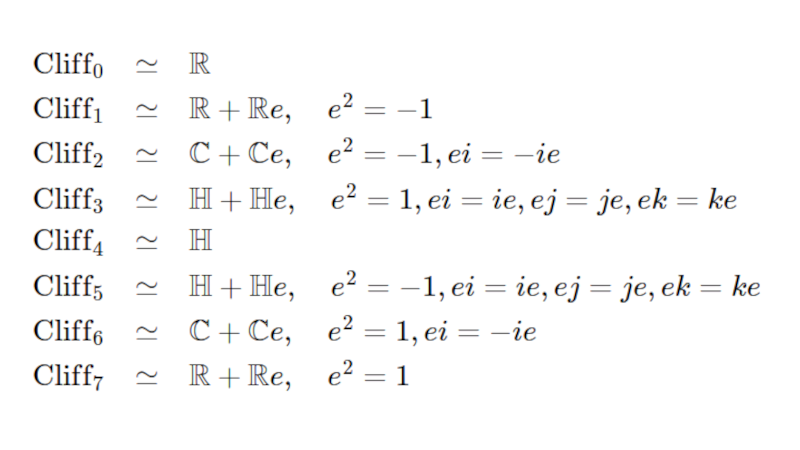
The recursion seems to add two perspectives to the beginning. But actually, those perspectives are already there. The two perspectives are actually added to the end. They are both squaring to {$-1$} so they are contributing a copy of the quaternions {$\mathbb{H}$}.
As a tensor product, they are either
- 0 or 4 adding {$\mathbb{H}$}
- 1 or 5 completing {$\mathbb{H}$} and starting {$M_2(\mathbb{R}$}
- 2 or 6 adding {$M_2(\mathbb{R})$}
- 3 or 7 completing {$M_2(\mathbb{R})$} and starting {$\mathbb{H}$}
Clifford algebra recursions
The logic seems to be as follows.
A concept expresses consistency, which is the compatiblity (of syntax and semantics). It squares to {$+1$}. A context expresses inconsistency, which is the incompatibility (of syntax and semantics). It squares to {$-1$}. We can say that truth is consistency, falsehood is inconsistency, and truth and falsehood should go together (yielding consistency). Whereas two complementary truths are inconsistent as are two complementary falsehoods.
A concept should be paired with a context. They are compatible. A concept should not be paired with a concept. They are incompatible. Likewise, a context should not be paired with a context.
Two minimal algebras arise.
If we have two contexts, they square to {$-1$}, and then they are incompatible and thus their product squares to {$-1$}, also a context. This gives a three-cycle of contexts, thus the quaternions.
If we have two concepts {$A^2=+1, B^2=+1$}, then they are incompatible and their product {$AB$} yields a context {$(AB)^2-1$}. But this context is compatible with the concepts, and its product with either squares to {$+1$} and is a concept, namely, the other concept. This algebra is the matrices {$M_2(\mathbb{R})$}. The matrices can be written:
{$A= \begin{pmatrix} 1 & 0 \\ 0 & -1 \\ \end{pmatrix}, B= \begin{pmatrix} 0 & 1 \\ 1 & 0 \\ \end{pmatrix}, AB = \begin{pmatrix} 0 & 1 \\ -1 & 0 \\ \end{pmatrix} $}
If we have a concept and a context, then together they yield another context, which yields {$M_2(\mathbb{R}$}.
Expressing the linear complex structures {$J_1, J_2, J_3, \cdots$} as matrices
The recursion relations give rise to the linear complex structures {$J_1, J_2, J_3, \cdots$}.
{$J_1=i$} in the quaternions
{$J_2=j$} in the quaternions
{$J_3=k\otimes \begin{pmatrix} 1 & \\ & -1 \\ \end{pmatrix}$}
What is the relation between {$k\otimes \begin{pmatrix} 1 & \\ & -1 \\ \end{pmatrix}$} and {$\begin{pmatrix} 1 & \\ & -1 \\ \end{pmatrix}\otimes k$} ? Consider redoing the recursion relation.
{$J_4=k\otimes \begin{pmatrix} & 1 \\ 1 & \\ \end{pmatrix}$}
{$J_5=k\otimes \begin{pmatrix} & -1 \\ 1 & \\ \end{pmatrix} \otimes i_2$} where {$i_2 = \begin{pmatrix} & 1 & & \\ -1 & & & \\ & & & -1 \\ & & 1 & \\ \end{pmatrix} $}
{$J_6=k\otimes \begin{pmatrix} & -1 \\ 1 & \\ \end{pmatrix} \otimes j_2$} where {$j_2 = \begin{pmatrix} & & -1 & \\ & & & -1 \\ 1 & & & \\ & 1 & & \\ \end{pmatrix} $}
{$J_7=k\otimes \begin{pmatrix} & -1 \\ 1 & \\ \end{pmatrix} \otimes k_2 \otimes \begin{pmatrix} 1 & \\ & -1 \\ \end{pmatrix} $} where {$k_2 = \begin{pmatrix} & & & -1 \\ & & 1 & \\ & 1 & & \\ -1 & & & \\ \end{pmatrix} $}
{$J_8=k\otimes \begin{pmatrix} & -1 \\ 1 & \\ \end{pmatrix} \otimes k_2 \otimes \begin{pmatrix} & 1 \\ 1 & \\ \end{pmatrix} $}
What is the relation between {$J_1$} and {$J_9$}?
Charge conjugation symmetry {$C$}
The two symmetries {$C$} and {$JC$} (with real complex structure {$J$} playing the role of {$i$}) both square to {$+1$} or both square to {$-1$}. So they can be identified with the two generators added by the analogous Clifford algebra recursion relation.
Charge conjugation {$C$} expresses inaccessibility, the questioning mind, thus adds two perspectives: a perspective {$C$} and a perspective on a perspective {$JC$}.
Geodesics
Geodesics also have to do with the nature of {$J_iJ_{i+1}^{-1}=J_{i+1}J_i$}.
Fourth root of unity
The quantum symmetries can be understood to travel clockwise or counterclockwise. If counterclockwise, then
- {$C$} is like sine and starts at {$1$} for zero.
- {$T$} is like cosine and continues with {$-1$} for two.
Operation +3
More concepts
4 Conceptions of Nullsome, Onesome, Twosome, Threesome
These divisions contain zero frames or one frame.
2 Conceptions of Foursome, Fivesome, Sixsome, Sevensome
These divisions contain two frames or three frames.
Everything
{$O(16r)$}
{$\frak{g_1}$}
pseudoscalar
Division of Everything
Consider the Lie algebra decomposition {$\frak{g}=\frak{h}+\frak{m}$}.
Self
Hamiltonian models the self, the self-identity.
Step-in and step-out
A Hamiltonian {$H$} and its conjugate {$H^* = H^T$}.
Notes
Time reversal {$T$}
{$T^2=+1$} as complex conjugation combined with {$J^2=-1$} gives a real structure. Together with {$(JT)^2=-1$} the yield {$M_2(\mathbb{R})$}.
{$T^2=-1$} combined with {$J^2=-1$} along with {$(JT)^2=-1$} gives a quaternionic structure. Together they are the quaternions.
Frames of explicitness
The culling requires a change in sign after every second term. And this pattern can then be expressed in two different ways according to where it starts. And then the pattern can be made explicit in terms of + and -.
Perhaps each of these steps in explicitness establishes a frame. And we have a maximum of three frames and a collapse with the fourth frame.
Symmetric Monoidal Categories and Γ-Spaces
The row {$1 4 6 4 1$} splits into {$1 6 1$} ({$S^+$}) and {$4 4$} ({$S^-$}) which are outlooks both relevant for the eightfold way. We have {$\binom{4}{0}+\binom{4}{2}+\binom{4}{4}$} and {$\binom{4}{1}+\binom{4}{3}$}, which is to say, choosing even vs. choosing odd.
Whereas the row {$1 3 3 1$} has {$\binom{3}{0}+\binom{3}{2}$} and {$\binom{3}{1}+\binom{3}{3}$}.
The row {$1 2 1$} has {$\binom{2}{0}+\binom{2}{2}$} and {$\binom{2}{1}$}.
The row {$1 1$} has {$\binom{1}{0}$} and {$\binom{1}{1}$}.
The row {$1$} is collapsed and only has {$\binom{0}{0}$}. Does it relate to the fourth row?
{$D_n$} is the {$+1$}-eigenspace dimension minus the {$-1$}-eigenspace dimension.
What gives the signature: The number of basis elements that square to {$+1$} minus the number that square to {$-1$}.
The sequence {$D_n$} gives the number of basis elements that square to {$+1$} minus the number that square to {$-1$}.
{$e^{\pm n\frac{\pi}{4}i}=\frac{\sqrt{2}}{2}(1 \pm i)^n$}
{$$D_n=\underset{k\equiv 0,3(mod 4)}{\sum_{k}}\binom{n}{k}-\underset{k\equiv 1,2(mod 4)}{\sum_{k}}\binom{n}{k} = \sum_{k=0}^n\binom{n}{k}(-1)^{\frac{k(k+1)}{2}}=\sqrt{2}^{n+1} \cos ((n+1)\frac{\pi}{4})$$}
We have {$D_{n+4}=-4D_n$} and {$D_{n+8}=16D_n$}.
Compare and interpret {$(1\pm 1)^n$} and {$(1\pm i)^n$}.
Twofold complex Bott periodicity is based on the fact that two generators (squaring to {$+1$}) yield the two by two matrices.
The basic pattern is given by {$\binom{3}{0},\binom{2}{1},\binom{1}{2},\binom{0}{3}$} which is {$1,3,3,1$} as {$+,-,-,+$}. So it is rooted in the three minds but also the foursome. But this pattern regards the axes, which is to say, pairs of perspectives.
Consider the Cartan involution and the Cartan decomposition.
Pascal triangle rows: Odd: semantic inner pair vs. Even: syntactic outer pair.
L? kontekste Dievas tolygus viskam. (?) 6 Dievo kontekstai (?) Neprisimenu!