- MathNotebook
- MathConcepts
- StudyMath
- Geometry
- Logic
- Bott periodicity
- CategoryTheory
- FieldWithOneElement
- MathDiscovery
- Math Connections
Epistemology
- m a t h 4 w i s d o m - g m a i l
- +370 607 27 665
- My work is in the Public Domain for all to share freely.
- 读物 书 影片 维基百科
Introduction E9F5FC
Questions FFFFC0
Software
See: Bott periodicity, ATP Synthase
Investigation: Understand whether the Krebs cycle manifests Bott periodicity and/or divisions of everything.
| 三羧酸循环 | Sān suō suān xúnhuán |
Study ATP-ases
- How enzymes change the geometry and allow water to get close and establish bonds.
Study how dephosphorylation yields energy and what form that takes
- hydrolysis
- wet and dry zones - hydrophilic and hydrophobic
- dissociation - the four ways that a phosphate manifests (the number of hydrogen atoms)
- dephosphorylation and phosphorylation
- Study the energy released or required at each state of the Krebs cycle. Trace back where is the energy coming from. What are the environmental assumptions that are funneling into the Krebs cycle and driving it?
- Does the Krebs cycle manifest Bott periodicity and/or the divisions of everything?
- Consider how glycolysis may act in eight layers to establish geometry, derive noncontradiction from contradiction, and yield the eight-cycle.
Ideas
- Energy is released = an electron moves to a lower energy state, energy is required = an electron moves to a higher energy state.
- Breaking off the phosphate allows the double bond of an oxygen to be shared with the other oxygens. Whereas in the triphosphate this is restricted apparently.
- The molecule which receives a phosphate becomes much more reactant. ATP thus produces an phosphorylated intermediate.
- Hydrogen = real, oxygen = complex, carbon = quaternion.
- COOH - the two oxygens are conjugates
- Two carbons (in the middle) is an 8-dimensional matrix, four carbons are a 16-dimensional matrix.
Glycolysis takes place in the cytoplasm and forms two molecules of pyruvate per molecule of glucose.
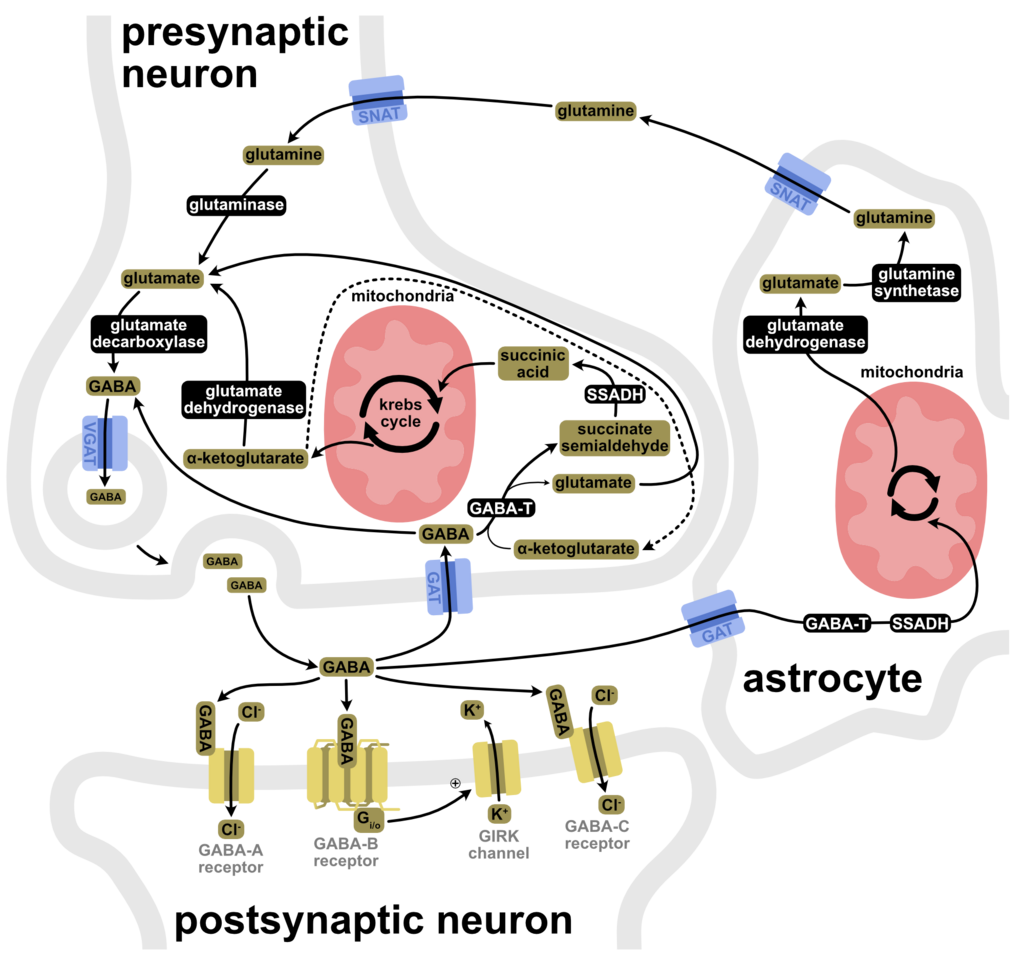
Krebs cycle relates neurotransmitters. It inputs GABA (the main inhibitor), outputs glutamate (the main excitator).
A carrier protein transports pyruvate into the mitochondrial matrix.
Inside the mitochondrial matrix, the enzyme pyruvate dehydrogenase oxidizes these pyruvate molecules to form acetyl coenzyme A, also known as acetyl-CoA. In this reaction, a molecule of carbon dioxide is generated and a molecule of NAD+ is reduced to NADH.
Acetyl-CoA is the key metabolic intermediate that links glycolysis and the citric acid cycle. (For clarity, we will not show the coenzyme portion of acetyl-CoA, and instead are simply representing it as the two-carbon molecule acetate.)
The citric acid cycle consists of the following eight steps. It also harvests chemical energy, producing a total of three NADH molecules.
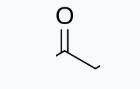 | Threesome (extra {$O$}) | 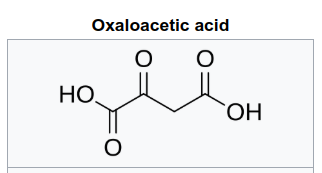 |
| 1) -31.4 KJ/Mol | Citrate synthase combines the two-carbon acetyl group from acetyl-CoA with the four-carbon molecule oxaloacetate. This generates the six-carbon molecule citrate. | 4+2=6 |
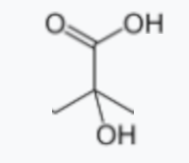 | Foursome (extra {$COH$} and {$COOH$} together)(or missing O) | 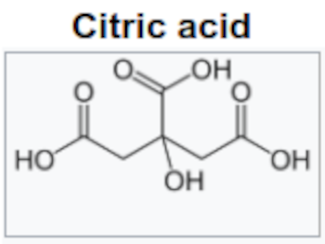 |
| 2) +6.3 KJ/Mol | Aconitase isomerizes citrate into isocitrate. | 6=6 |
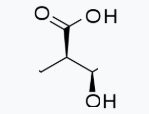 | Fivesome (extra {$COH$} and {$COOH$} separately)(or missing O) | 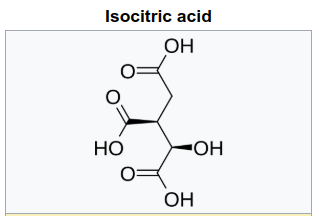 |
| 3) -8.4 KJ/Mol | Isocitrate dehydrogenase oxidizes isocitrate to generate the five-carbon molecule alpha-ketoglutarate. | 6-1=5 One carbon dioxide molecule is released, and one NAD+ molecule is reduced to NADH. |
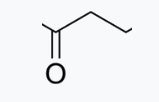 | Sixsome (extra {$CO_2$}) | 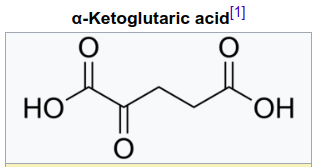 |
| 4) -30.1 KJ/Mol | Alpha-ketoglutarate dehydrogenase decarboxylates and oxidizes alpha-ketoglutarate, which combines with coenzyme A (21 carbons) to form succinyl-CoA (25 carbons). | 5-1+21=25 This produces a molecule of carbon dioxide). A molecule of NAD+ is reduced to form NADH. |
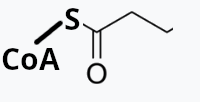 | Sevensome (bookends ({$COOH$}) replaced by {$COOOH$} and {$S-CoA$}) | 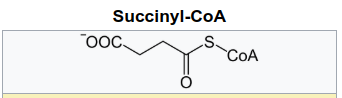 |
| 5) -3.3 KJ/Mol | Succinyl-CoA synthetase converts succinyl coenzyme A into succinate, releasing coenzyme A. | 25-21=4 This produces one molecule of high-energy GTP. |
 | Nullsome (base) | 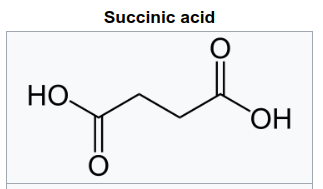 |
| 6) 0 KJ/Mol | Succinate dehydrogenase, embedded in the inner mitochondrial membrane, and a component of the electron transport chain, in which it is called Complex II, oxidizes succinate to fumarate. | 4=4 Complex II receives two electrons that it will ultimately pass on to coenzyme Q, which in turn will deliver its electrons to Complex III. Complex II uses FAD rather than NAD+ to accept electrons. |
 | Onesome (extra bond) | 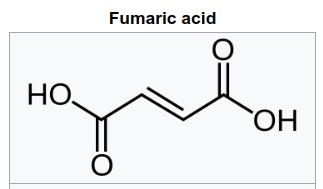 |
| 7) -3.8 KJ/Mol | Fumarase converts fumarate to malate. | 4=4 |
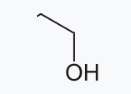 | Twosome (extra OH) | 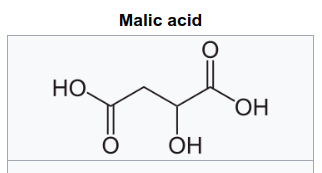 |
| 8) +29.7 KJ/Mol | Malate dehydrogenase oxidizes malate to re-form oxaloacetate | 4=4 This reduces a molecule of NAD+ to NADH in the process. |
| Threesome (extra {$O$}) | |
| 9) | 4+2=6 |
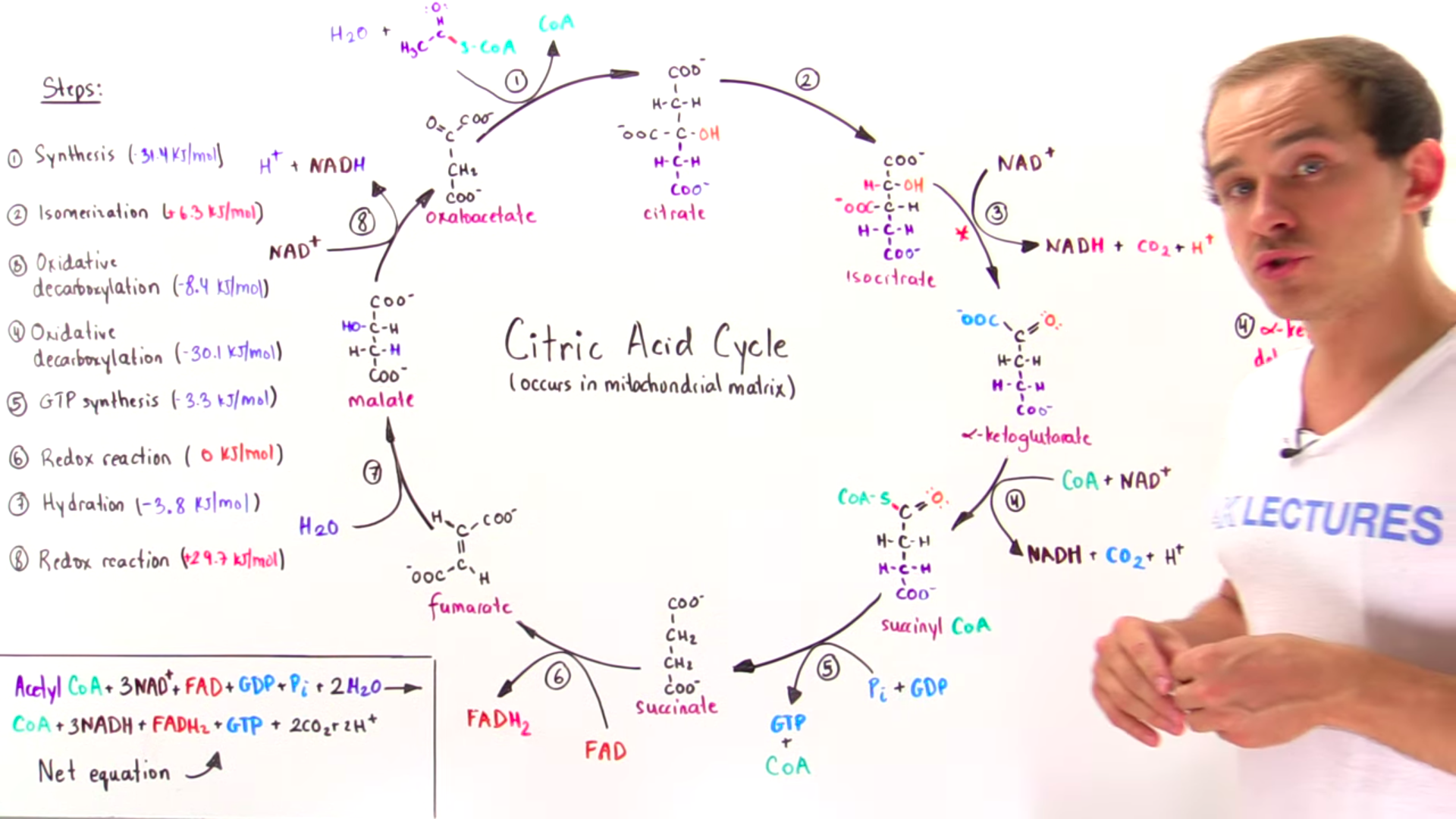
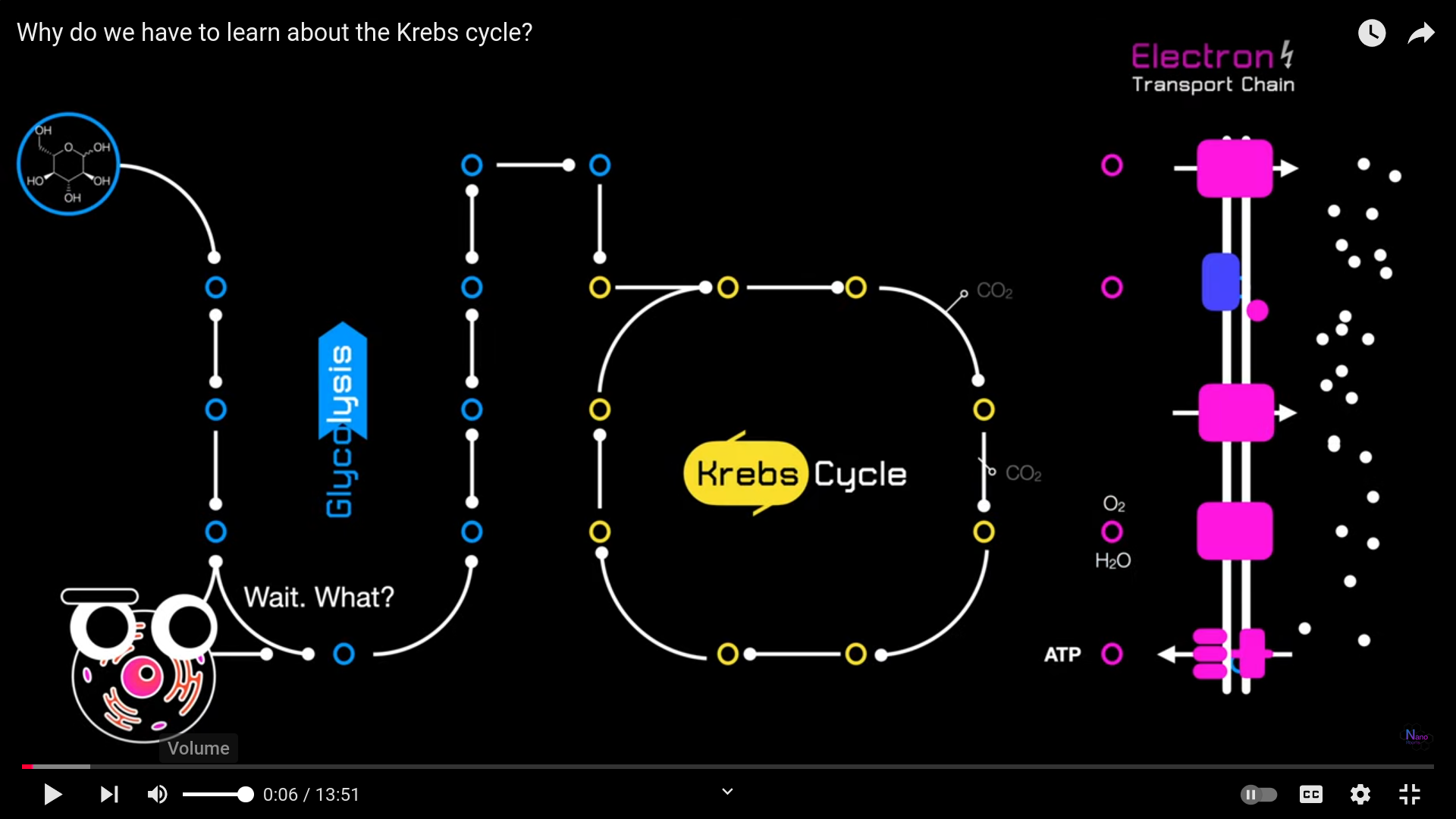
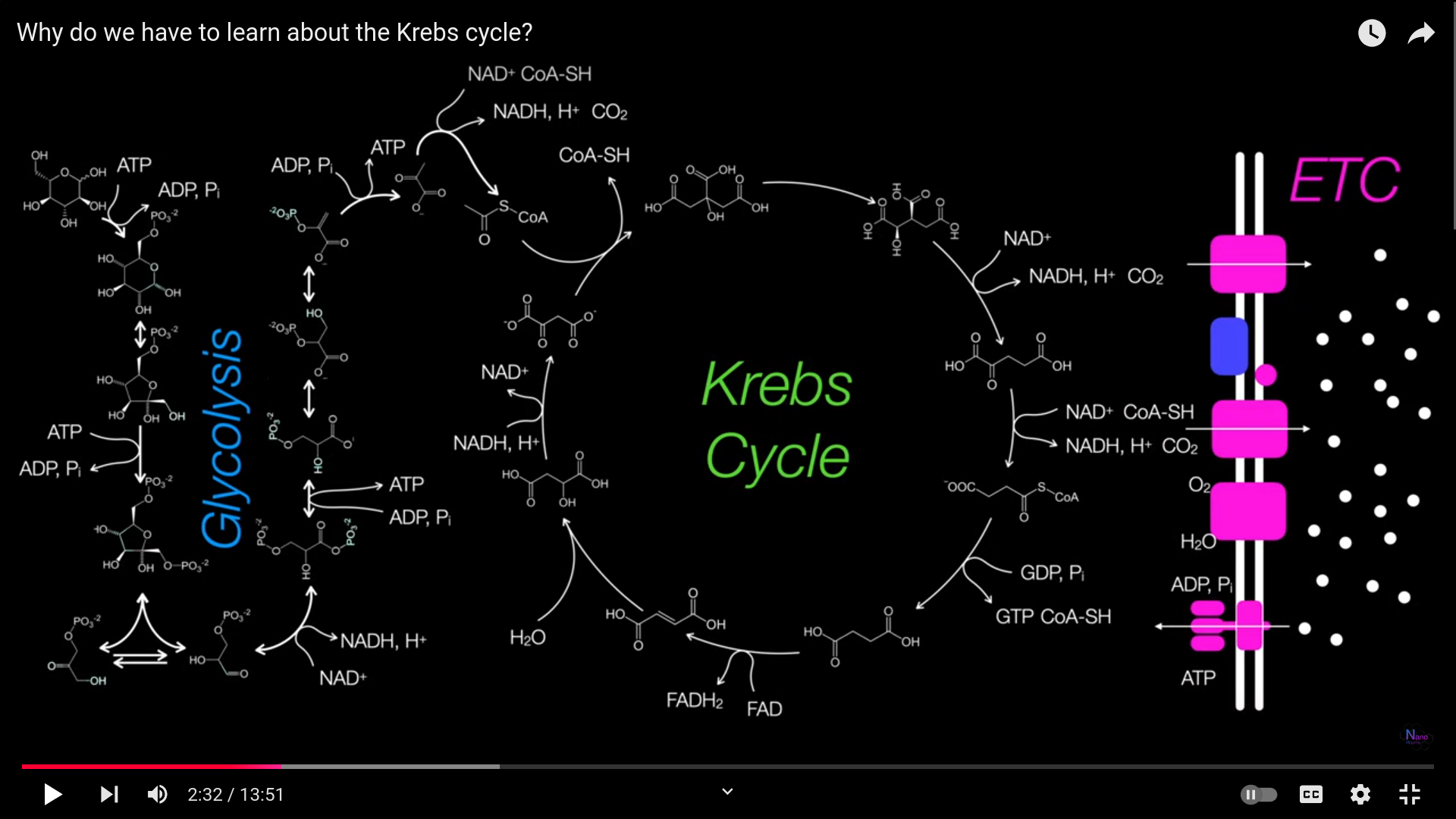
Nick Lane. Transformer. Krebs Cycle.
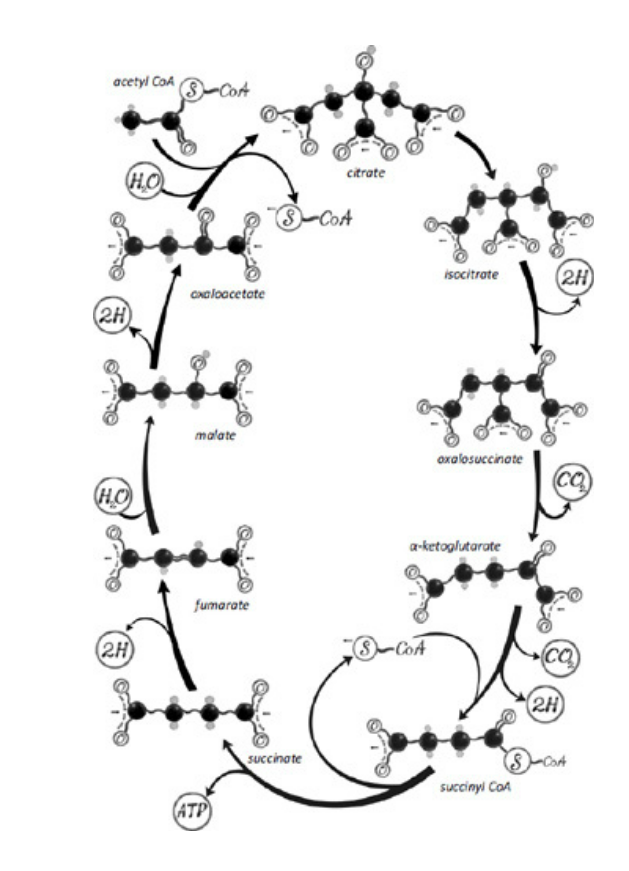
There are eight enzymes
| Enzyme | Reaction type |
| Citrate synthase | Aldol condensation |
| Aconitase | Dehydration, Hydration |
| Isocitrate dehydrogenase | Oxidation, Decarboxylation |
| α-Ketoglutarate dehydrogenase, Thiamine pyrophosphate, Lipoic acid, Mg++,transsuccinytase | Oxidative decarboxylation |
| Succinyl-CoA synthetase | Substrate-level phosphorylation |
| Succinate dehydrogenase | Oxidation |
| Fumarase | Hydration |
| Malate dehydrogenase | Oxidation |
读物
 Nanorooms. Why do we have to learn about the Krebs cycle?
- Citric acid cycle
- Nick Lane. Transformer (preview)
- Stuart Harrison, Nick Lane et al. Life as a Guide to its Own Origins
- Aaron Halpern, Nick Lane et al. Biophysical Interactions Underpin the Emergence of Information in the Genetic Code.
Krebs cycle is an eightfold cycle in one direction, oxidising, as in fueling the brain. This is the direction in which it could manifest consciousness.
Carboxylic acid expresses the twosome, as the oxygen connects two possibilities, the hydrogen and the carbon backbone of the molecule. The hydrogen can exist or not - opposites coexist - and the carbon based molecule which exists. I had in mind the structure {$C-O-H$} but a carboxylic acid has the structure {$O=C-O-H$} where the C is connected to the rest of the molecule. But note that actually the carboxylic anion (with an extra electron because the hydrogen is missing) has opposites coexist - there is an electron and a missing electron - whereas accepting a proton resolves this and we have all is the same, we have completion, determination, as to which oxygen is which.
Krebs cycle - do the tricarboxylic acids express triambiguity of operators +1, +2, +3? where the emphasis is on any one of the three carboxylic acids in a molecule?
The purpose of life is to hydrogenate carbon dioxide. {$CO_2$} becomes methane {$CH_4$}. (Is this relating the mind that knows and the mind that does not know?) The Krebs cycle is the low energy state for that. Is methane related to the eightsome?
- Methane is a tetrahedron!
- Methane burns: {$CH_4+O_2=CO_2+2H_2O$}.
- The reverse process is the hydrogenation of carbon dioxide: {$CO_2+2H_2O=CH_4+O_2$}
ATP is {$C_{10}H_{16}N_5O_{13}P_3$}. Hydrogen has 1, Carbon 6, Nitrogen 7, Oxygen 8, Phosphorus 15 protons. Thus the total number of protons in ATP is 60 + 16 + 35 + 104 + 45 = 260.
In the world of spiritual requirements for material implementations: Eightfold cycles for consciousness? Citric acid cycle | Citric acid cycle (Krebs cycle), Calvin cycle (photosynthesis). Compare with Glyoxylate cycle and Reverse Citric acid cycle (reverse Krebs cycle).
- Nick Lane. How the Krebs cycle powers life and death. Consciousness and the citric acid cycle. Nick Lane described an idea by Luca Turin. Electromagnetic fields at the boundary of mitochondria give feedback to the Krebs cycle.
- Nick Lane. Transformer: The Deep Chemistry of Life and Death. and other books.
The Kreb cycle functions as a switch, turning forwards or backwards. Does one direction (energy?) represent the unconsious +1, the other direction (growth?) represent the conscious +2, with consciouness functioning as the switch? Can we foster alternation between stepping in and stepping out?
Think about characterizing the chemical soup in which interactions take place. There is the solvent (like water) and the solute forming a uniformly distributed solution. Can there be a gradient? Then pH is an important characteristic which can lead to an electric gradient if there is a boundary with a zone with a different charge or different pH.
Reproduction - replication - is a type of flow, recurring activity, a form of persistence in terms of flow rather than material
Kevin Mitchell, Henry Potter. Naturalising Agent Causation
- https://www.amazon.com/Free-Agents-Evolution-Gave-Will/dp/0691226237
- (1) thermodynamic autonomy - isolated from disruptive environment, (2) persistence - the origin of purpose, (3) endogenous activity, (4) holistic integration, (5) low‐level indeterminacy, (6) multiple realisability, (7) historicity, (8) agent‐level normativity
- A scientific experiment eliminates noise which simplifies the analysis of causality but is unreal. Noise, as in John's dynamics, is normal.
- Causation is interpretative - looking for difference makers - neural populations do that. There can be multiple responsible parties but many of them are assumed and unexamined.
Kevin Michell, "Free agents" - how agency evolved from single cell animals
Thomas Parr. Message Passing and Metabolism. Glycolysis pathway. Can we apply active inference to the Krebs cycle? and relate to Bott periodicity?