- MathNotebook
- MathConcepts
- StudyMath
- Geometry
- Logic
- Bott periodicity
- CategoryTheory
- FieldWithOneElement
- MathDiscovery
- Math Connections
Epistemology
- m a t h 4 w i s d o m - g m a i l
- +370 607 27 665
- My work is in the Public Domain for all to share freely.
- 读物 书 影片 维基百科
Introduction E9F5FC
Questions FFFFC0
Software
Exceptional Lie algebras
In 1893, Élie Cartan published a note describing an open set in {$\mathbb {C} ^{5}$} equipped with a 2-dimensional distribution—that is, a smoothly varying field of 2-dimensional subspaces of the tangent space—for which the Lie algebra {${\mathfrak{g}}_2$} appears as the infinitesimal symmetries. In the same year, in the same journal, Engel noticed the same thing. Later it was discovered that the 2-dimensional distribution is closely related to a ball rolling on another ball. The space of configurations of the rolling ball is 5-dimensional, with a 2-dimensional distribution that describes motions of the ball where it rolls without slipping or twisting.
In 1900, Engel discovered that a generic antisymmetric trilinear form (or 3-form) on a 7-dimensional complex vector space is preserved by a group isomorphic to the complex form of {$G_2$}.
In 1908 Cartan mentioned that the automorphism group of the octonions is a 14-dimensional simple Lie group. In 1914 he stated that this is the compact real form of {$G_2$}.
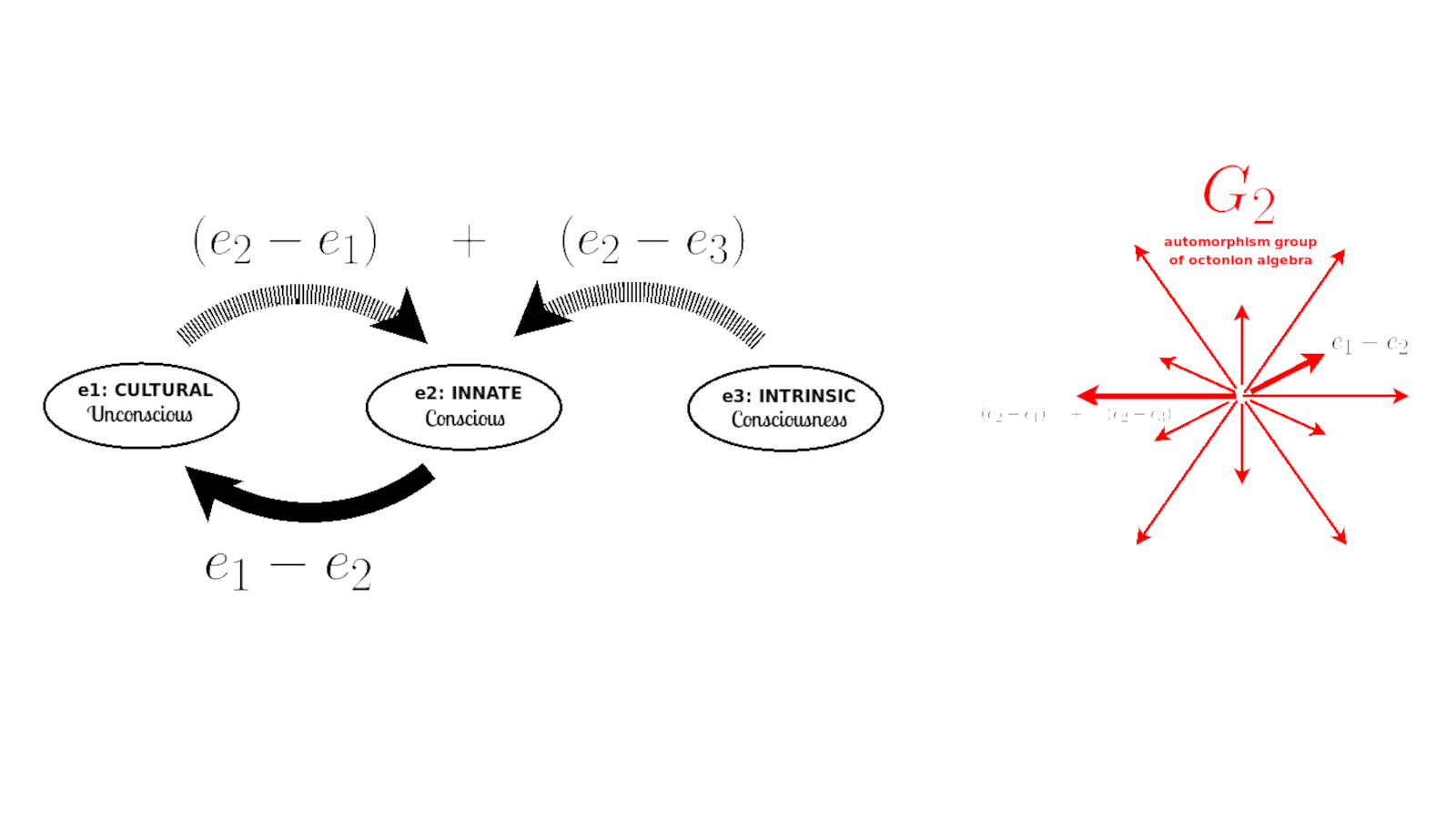
Note: α and A together form root system identical to {$A_2$} while the system formed by β and B is isomorphic to {$A_2$}.
Its Weyl/Coxeter group {$G=W(G_{2})$} is the dihedral group D_6 of order 12.
Polygon is 1 6 6 2 oriented faces du tetrahedrai dualumas.
