- MathNotebook
- MathConcepts
- StudyMath
- Geometry
- Logic
- Bott periodicity
- CategoryTheory
- FieldWithOneElement
- MathDiscovery
- Math Connections
Epistemology
- m a t h 4 w i s d o m - g m a i l
- +370 607 27 665
- My work is in the Public Domain for all to share freely.
- 读物 书 影片 维基百科
Introduction E9F5FC
Questions FFFFC0
Software
Understand the choice frameworks.
- How do the choice frameworks express the four conceptions of the nullsome?
- How do the choice frameworks and the Schlafli symbols relate to the root systems and the Dynkin diagrams?
- How do the choice frameworks relate to the possibilities for polytopes, especially infinite families of polytopes?
- How do the choice frameworks added to the sixsome of the Fano plane yield the four reservations, the four conceptions of the eightsome?
- How can choice frameworks be expressed with category theory?
The four choice frameworks express what it means for us to be choosing. They also express what it means for us to be not choosing. This is given by interpreting the top of the relevant variant of Pascal's triangle, where no choice has been made.
The four choice frameworks thus express the four conceptions of the nullsome, how we conceive that God goes beyond himself into himself, separated from himself by nothing, something, anything, everything. God does not know these scopes but rather wishes for them. Whereas human knows these scopes but does not wish for them.
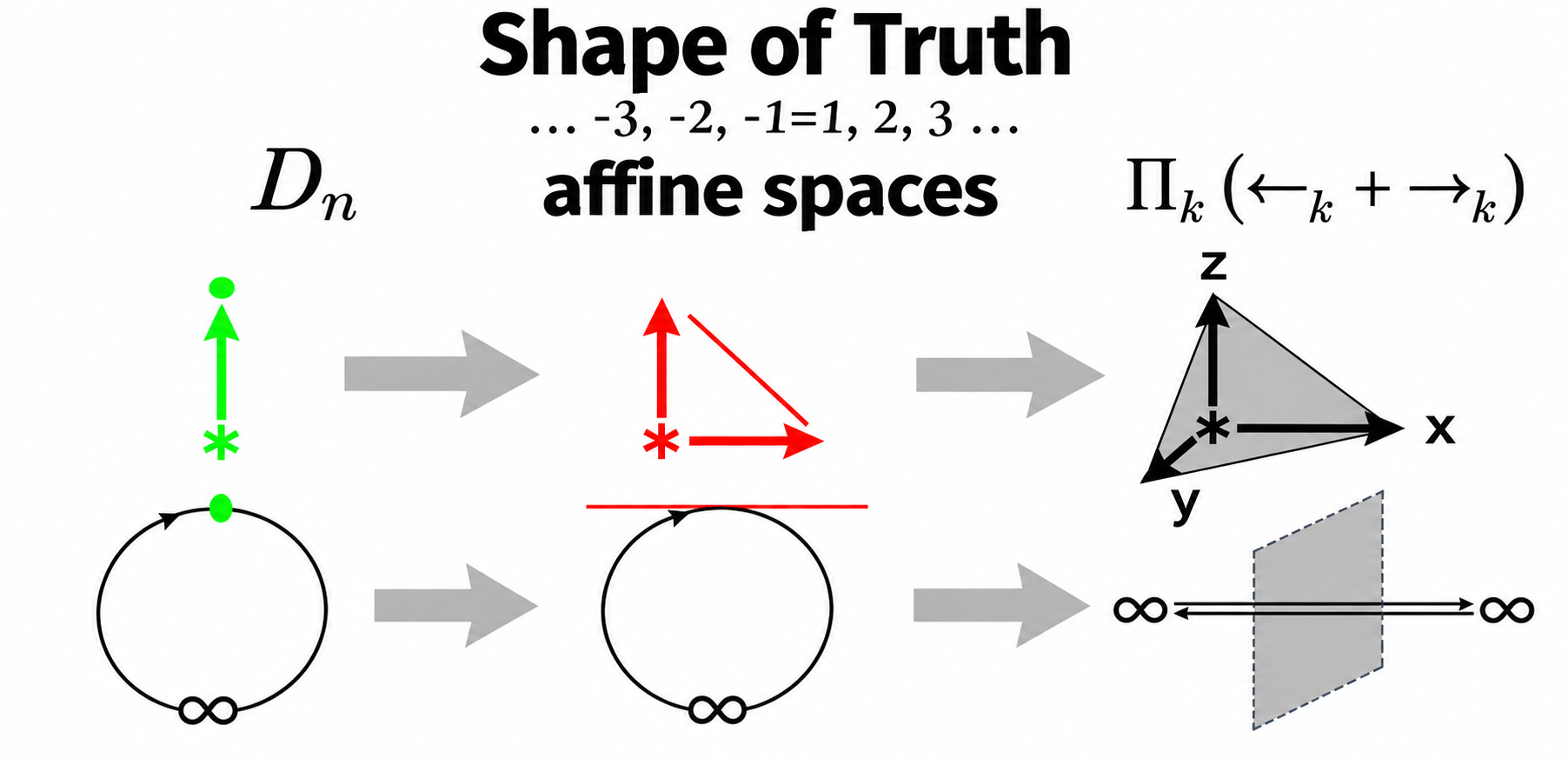
Unfolding is given by three angles as with truth (necessary, actual, possible) which negates Whether, knowing nothing. A broader scope for freedom arises with a fourth angle, which can be presented at the end of the unfolding, as a square, within which there is the center - not knowing something, not What - thus directness. Or at the beginning of the unfolding, from the center, as a cross relating four angles, allowing for independent directions, thus anything. Or we can have both at the beginning and the end, compatibly, which yields the hypercubes, but also simplex structure at each of the local centers of odd parity, which is compatible.
The center is direct (spirit) and the vertices are reflected (structure)
- The center keeps spawning a new vertex and recentering itself accordingly. The center and vertex are separated by nothing. God (center) makes way for everything (vertex) and rearises (as the center), thereby wishes for nothing. Whereas the vertex (as human) knows nothing.
- The center is absent and the whole is repeatedly cut and divided by mirrors into direct and reflected. This expresses attention to the direct and constrains the center into a nonexpressed something. There is something from the volume looking in towards a corner, a center. The volume reaches towards the center, which is in something, in what, as whether behind it, hidden in it.
- The center is present and it keeps generating axes which are choices, defining a nonexpressed continuum linking them before the choice, thus expressing constancy of anything along that axis but also anything along the dimensions. The center is paired with the volume at infinity. There is anything looking out from the center to the volume. The center reaches out to the volume at infinity across anything, across all possible structures.
- The center is dispersed as the odd parity local centers supporting the vertices as the even parity. The odd centers and even vertices are separated by everything.
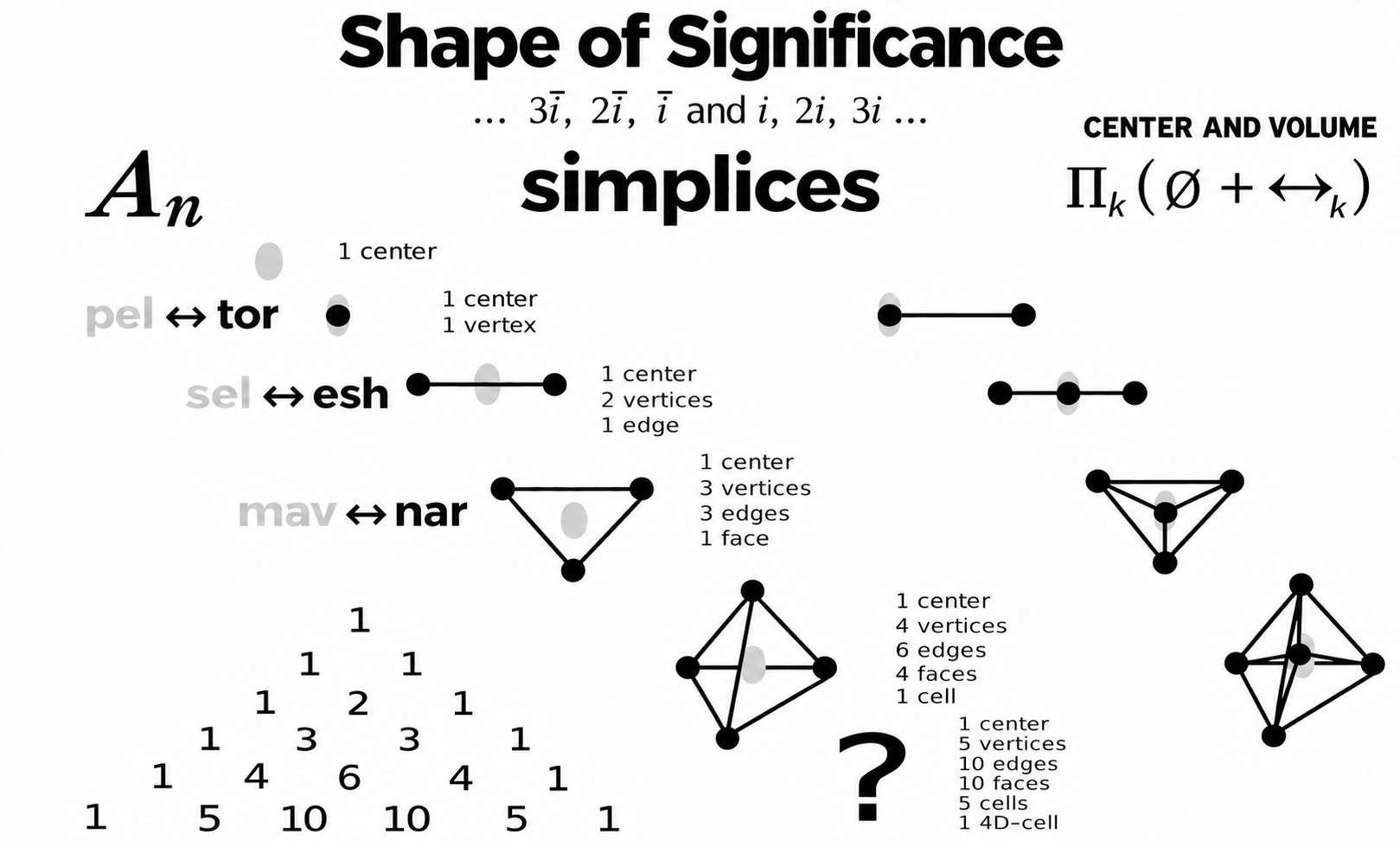
{$S(n,j)=S(n-1,j-1)+S(n-1,j)$}
A new vertex either is added to an existing subsimplex or is not.
Schlafli symbol {$\{3, 3, 3, \cdots , 3, 3, 3\}$}
- Facets have Schlafli symbol {$\{3, 3, 3, 3, \cdots , 3\}$}
- Vertex figures have Schlafli symbol {$\{3, 3, 3, \cdots , 3, 3\}$}
Truth is what cannot be hidden, what is obvious. It is not knowing nothing.
- Necessary: the consequences are obvious, truth by contradiction: the truth is in the vertex
- Actual: the grounds are obvious, truth by grounds and consequences: the truth is in the center
- Possible: the implication is obvious, truth by self-consistency: the truth is in the progression
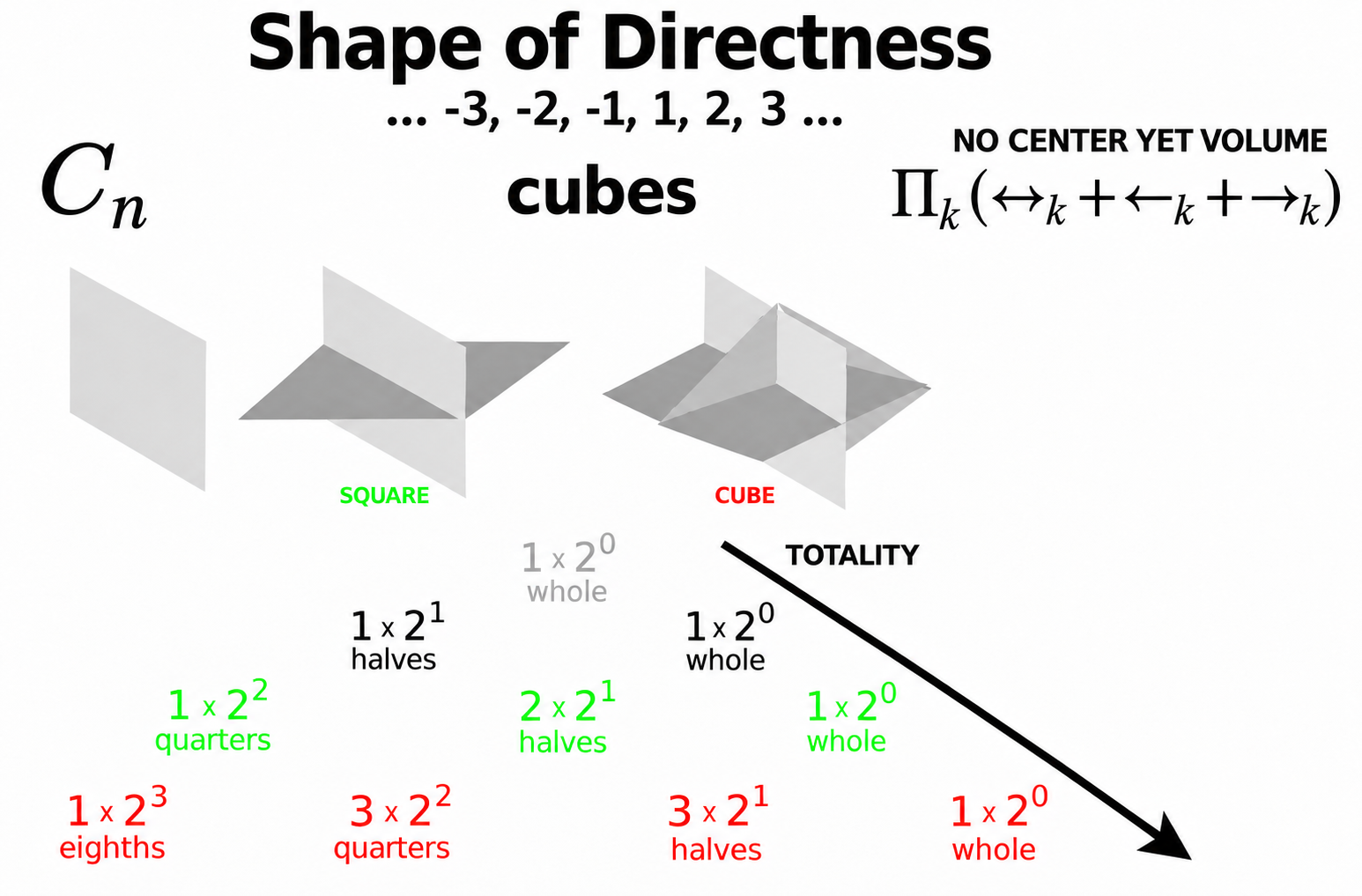
{$S(n,j)=S(n-1,j-1)+ 2 S(n-1,j)$}
A new dimension either destroys the context for an existing face by introducing a distinction, like a mirror, yielding halves, tending towards atoms, or it does not, thus rather supports the context for the existing face, by maintaining wholeness.
Schlafli symbol {$\{4, 3, 3, 3, \cdots , 3\}$}
- Facets have Schlafli symbol {$\{4, 3, 3, 3, \cdots , 3\}$}
- Vertex figures have Schlafli symbol {$\{3, 3, 3, \cdots , 3, 3\}$}
Direct is what is not mediated, not knowledge of something. It is not knowing something.
- Object: attention is directed not to itself. This is the end mirror, directed to the end atom, which supposes a final n, a final hypercube. Each mirror distinguishes what is direct and what is reflected. The object is that something which is fully specified. It has the fourfold square face.
- Process: attention is directed to itself. This is the case along the way. It has the threefold simplex nature.
- Subject: chooses what to pay attention to. This is the original volume before the mirror.
God is
Simple root counting system is folded.
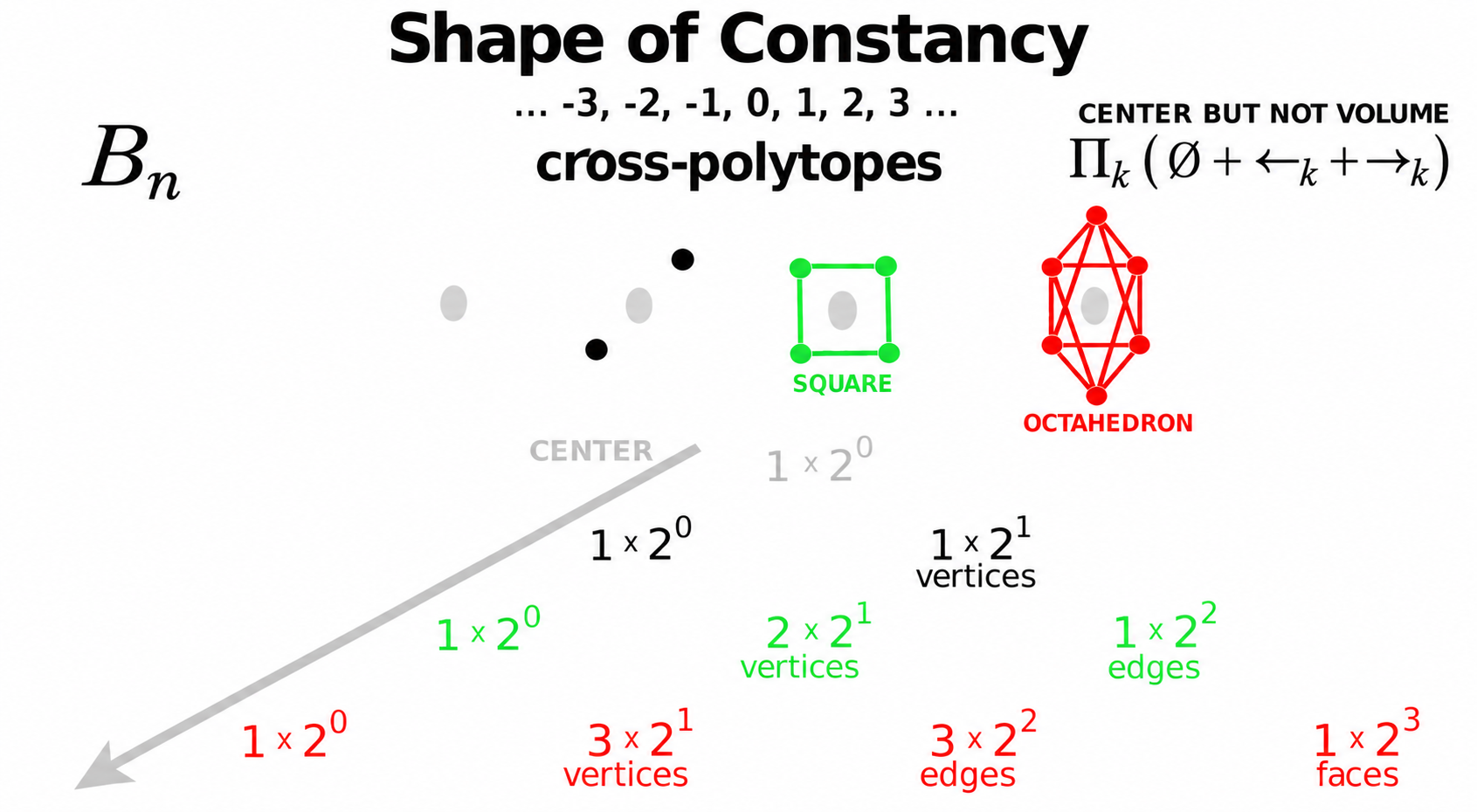
{$S(n,j)=2 S(n-1,j-1)+S(n-1,j)$}
A new axis is either included in an existing face, choosing one or the other end as a vertex, or it is not.
Schlafli symbol {$\{3, 3, 3, \cdots , 3, 3, 4\}$}
- Facets have Schlafli symbol {$\{3, 3, 3, \cdots , 3, 3\}$}
- Vertex figures have Schlafli symbol {$\{3, 3, 3, \cdots , 3, 4\}$}
Constant is what we search for, what is not changing. This is not knowing anything.
- One: We may find one example of constancy. This is some particular axis, for which a choice of vertex is not made, thus we have the continuous line between them, which expresses constancy along that line.
- All: If we don't find such an example, then we have the line from the original center to the volume at infinity. Thus all is constantly not constant.
- Many: This says that we select an axis but thwn we judge its vertex, and likewise, whether to include it in a face or not.
Simple root counting system has an external zero.
{$2^{n-1}\binom{n}{n+1-j} + 2^j\binom{n}{j}$}
{$S(n,j)=2 S(n-1,j-1)+2 S(n-1,j)$}
{$H(n,j)= H(n-1,j-1)+ 2 H(n-1,j)$}
Significant is what we can't encompass. It is not knowing everything. This is understanding the cube as pairing centers (odd parity) and vertices (even parity). Each dimension adds a new coordinate vector, a new neighbor for the local center.
- Being: The vertex is.
- Doing: The vertex interacts with local centers, its neighbors.
- Thinking: The center defines the simplex given by its neighbors, the surrounding vertices.
Simple root counting system is fused.
Regular polytopes
- Wikipedia: Regular polytope
- MathWorld: Regular polytope explains the classification in terms of the Gram matrix and its trigonometric constraints
- Spencer Whitehead. Classifying Regular Polyhedra and Polytopes using Wythoff’s Construction.
Euler's formula: 0 = 1 - V + E - F + 1
- 0 = 1 - 8 + 12 - 6 + 1
- 0 = 1 - 4 + 6 - 4 + 1
Notes
- The binomial can be interpreted in terms of what is not (as with structure) whereby two different nonexistences are the same. Or interpreted in terms of what is (as with spirit) whereby two different nonexistences are different.
- Choice frameworks are logics (as with proof by contradiction - which is asymmetric)
- A category with a zero object has semantic symmetry with regard to choice frameworks. A category without a zero object, but with initial objects and terminal objects which differ, such as the categories Set or Cat, have syntactic asymmetry.